Security Testing Tools
AutoCrypt CSTP Compliance
Integrated Platform for Automated Security Testing
Comprehensive Security Vulnerability Validation with CSTP Compliance
Global automotive cybersecurity regulations and standards, including UNECE R155/R156 and GB 44495, require manufacturers to validate the effectiveness of cybersecurity measures for type approval and throughout the vehicle lifecycle.
Regular cybersecurity testing is needed to identify, assess, and mitigate potential risks, requiring specialized tools and integrated infrastructure to address diverse regulatory requirements and manage complex testing results.
AutoCrypt CSTP Compliance is an integrated automotive cybersecurity validation platform that identifies key vehicle vulnerabilities, supports automated testing and system integration, and enables efficient compliance with global cybersecurity requirements.

Key Features
Flexible Testing for Evolving Requirements

Standards-based Test Cases
Supports standardized test cases applicable across diverse testing scenarios and environments.

Extensible Test Case Coverage
Provides a modular testing framework adaptable to diverse OEM and Tier supplier controller environments.

Adaptable Licensing Options
Supports the selection and purchase of testing modules according to requirements.

Integrated Reporting Results
Consolidates testing and analysis results into comprehensive reports for efficient decision-making.
System Architecture
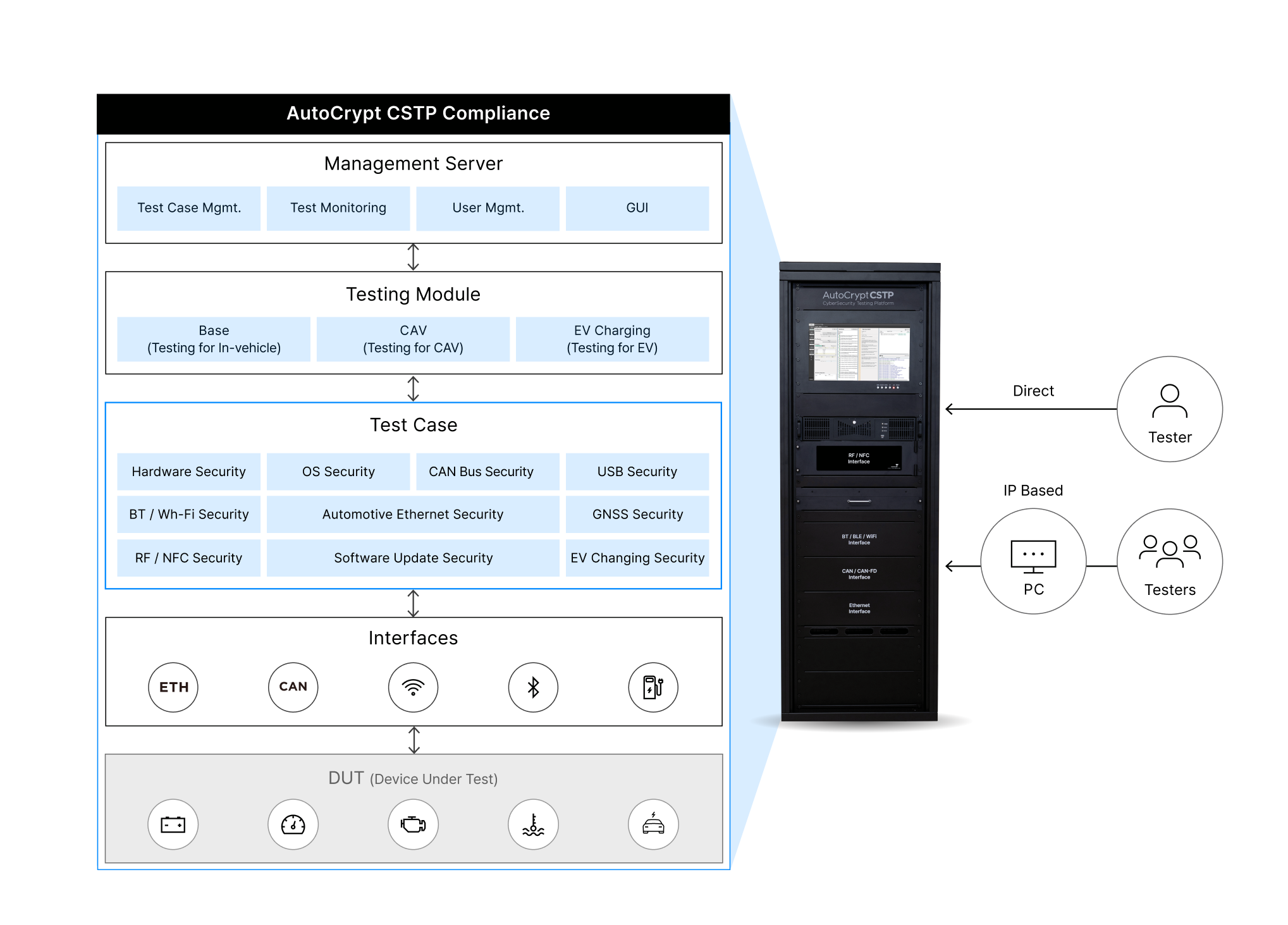
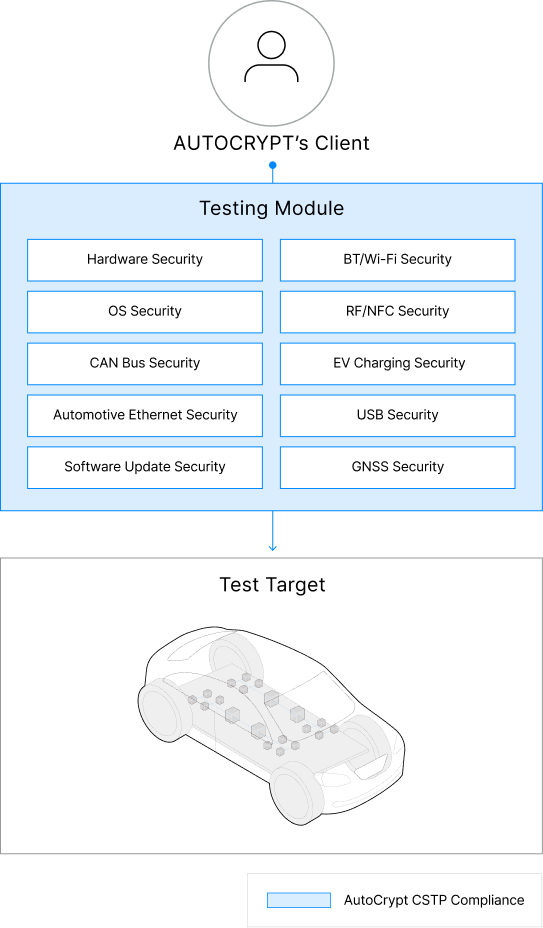
AutoCrypt CSTP Compliance is an integrated cybersecurity testing platform that manages the entire process from test management to validation within a single system. The intuitive web-based graphical user interface (GUI) enables direct on-site testing of vehicles and ECUs, with remote access and control through an internal IP network.
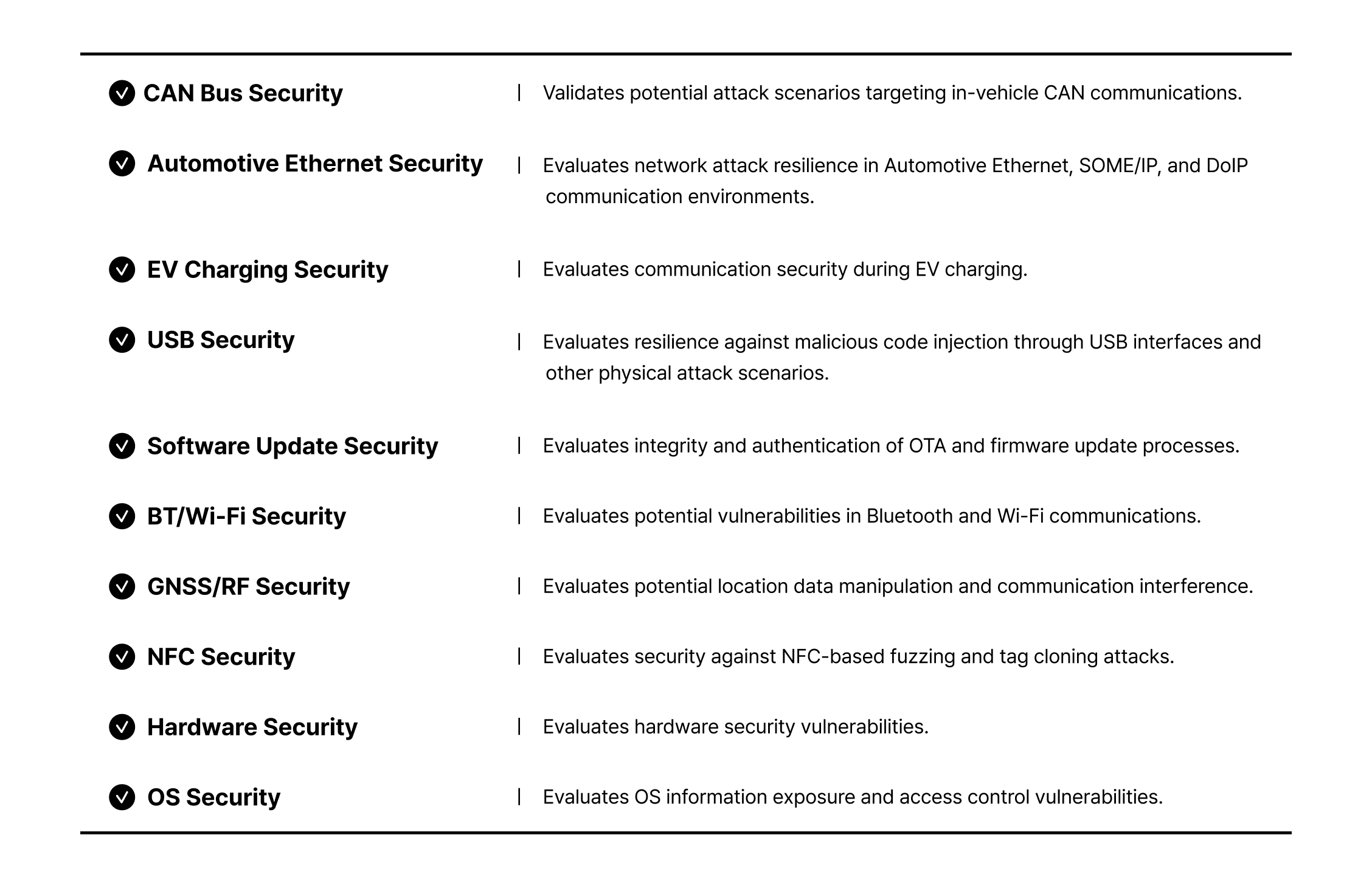
Technical Coverage
Highlights
Why AUTOCRYPT
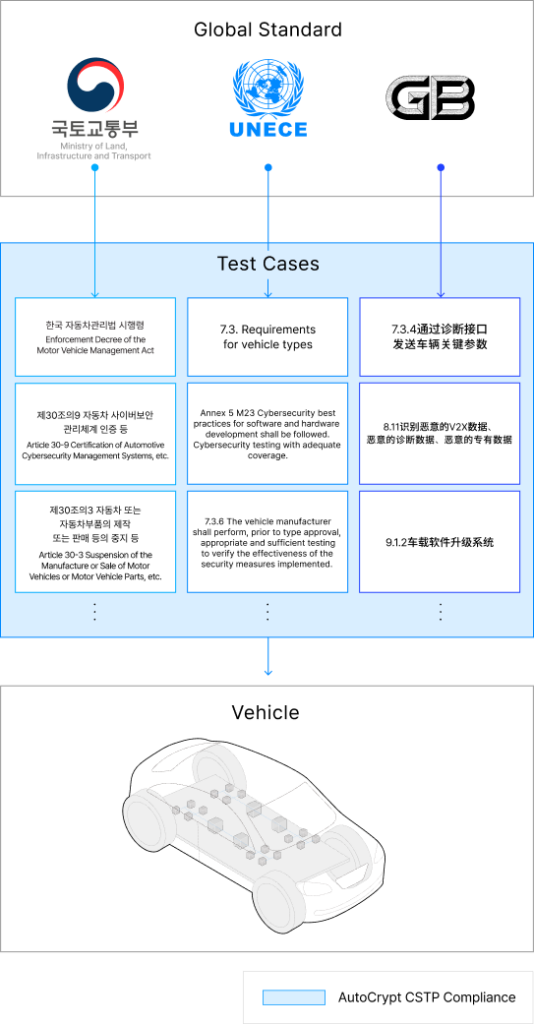
1. Standards-based Test Coverage
Comprehensive Test Case coverage aligned with automotive cybersecurity standards
- Universal Test Cases accommodate a variety of scenarios and environments, enhancing overall product stability and reliability.
- Standards-aligned Test Cases provide consistent security validation across different testing environments.
- Regular Test Case updates and technical support enable rapid adaptation to evolving standards and technologies.
2. Extensible Test Case Coverage
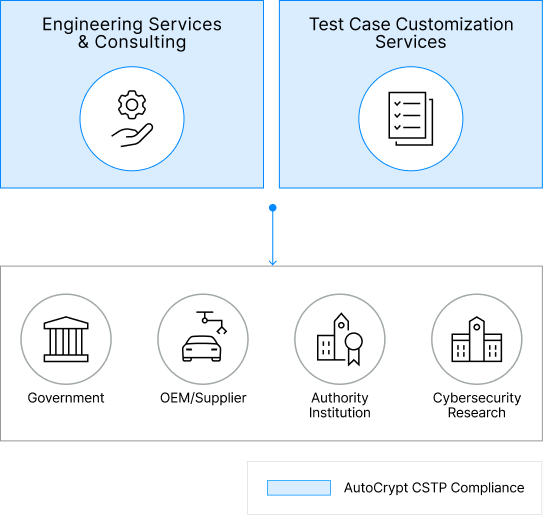
Modular testing framework adaptable to diverse OEM and Tier supplier controller environments.
- Testing environments configured based on manufacturer cybersecurity requirements and individual vehicle characteristics.
- Tailored test scenarios provide an integrated testing environment optimized for OEM and Tier supplier needs.
- Test Case optimization and technical support ensure rapid adaptation to changes in target firmware and vehicle models.
3. Adaptable Licensing Options
Flexible licensing options tailored to specific testing requirements
- Module-based licensing allows the selection of Test Cases according to specific objectives and requirements.
- Selective Testing Module licensing enables cost-efficient operations by allowing users to license only the modules required.
- Flexible license expansion supports efficient resource allocation and adaptation to evolving project requirements.
4. Comprehensive Report Support
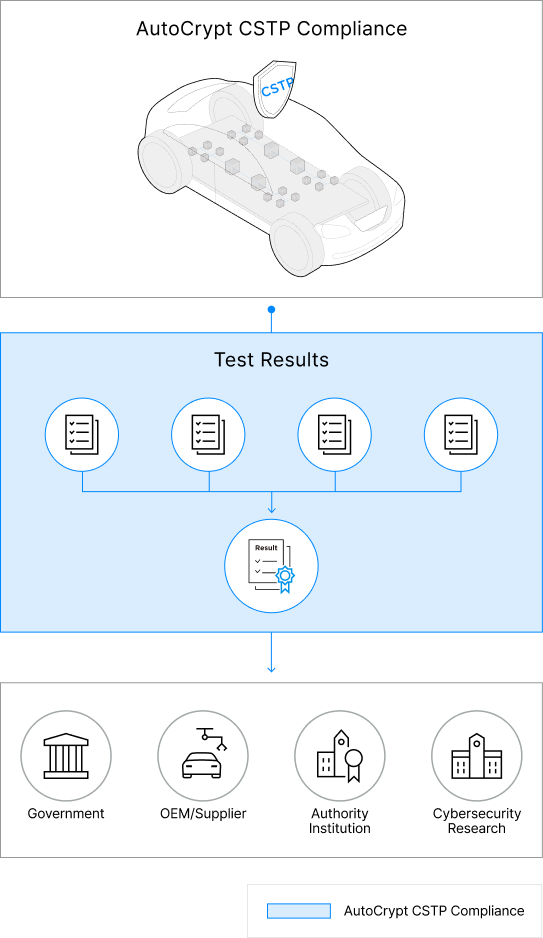
Consolidated test results at the Test Case Level
- Integrated reporting provides Test Case results across all supported Testing Types.
- Consolidated results and analysis facilitate efficient verification and accurate decision-making.
- Regulation-mapped Test Case results provide evidence to support global automotive cybersecurity compliance.
Certificates and References
Hardware Line-up
![[CSTP Compliance] Highlights_Hardware Line-up](https://autocrypt.io/wp-content/uploads/2026/09/AutoCrypt-CSTP-Why-AUTOCRYPT_Hardware-Line-up-e1788831059308.png)

Related Product
AutoCrypt CSTP
AutoCrypt CSTP is a comprehensive platform that offers a variety of security tests and validations and allows them to be executed and managed on one single platform.

About AUTOCRYPT
AUTOCRYPT
AUTOCRYPT is a mobility security provider with the goal of providing a seamless and secure mobility experience for all.