AUTOCRYPT, a leading automotive and AI cybersecurity solutions provider, announced that its V2X Public Key Infrastructure (PKI) service (Link) has officially obtained WebTrust certification through an independent third-party audit, confirming that the company meets globally recognized standards for PKI operations, security controls, certificate issuance, and lifecycle management.
Supporting V2X PKI and SCMS deployments across multiple countries, including nationwide-scale infrastructure projects, AUTOCRYPT’s certified infrastructure enables scalable certificate issuance, renewal, and revocation management (CRL/CTL) while serving as a trusted Root of Trust for V2X message security.
“As V2X ecosystems move from pilot programs to nationwide deployments, trust infrastructure becomes foundational rather than optional,” said Seokwoo Lee, Founder and CEO of AUTOCRYPT. “This accreditation validates our capability not only to issue certificates securely, but also to support scalable, long-term PKI operations across OEM and transportation ecosystems.”
With V2X deployments accelerating globally, AUTOCRYPT plans to continue expanding trusted PKI technologies including large-scale certificate lifecycle management, interoperability support, and future-ready security capabilities. AUTOCRYPT will further highlight these initiatives and its V2X solutions portfolio (Link) at the ITS America Conference & Expo 2026 from June 10–12 at Booth #6045 (Link).
AUTOCRYPT is a leading automotive cybersecurity provider delivering trusted security infrastructure for connected and software-defined vehicles. The company provides V2X PKI/SCMS, KMS, cybersecurity validation platforms, IDS/vSOC, and compliance solutions supporting OEMs and transportation agencies globally.
AUTOCRYPT, a leading global provider of digital key and automotive cybersecurity solutions, announceditsparticipationatthe 2026 Consumer Electronic Show (CES) in Las Vegas from January 6-9, whereitwillpresentitsfoundational and future-readysecuritysolutions.
Showcasing technologies that protect every layer of mobility, AUTOCRYPT will demonstrate three interconnected domains of expertise:
End-to-End Vehicle Key Management System: AUTOCRYPT’s key management infrastructure provides full-lifecycle generation, distribution, authentication, and access control of cryptographic keys across both on-board and off-board environments. By combining Public Key Infrastructure (PKI) and the Key Management System (KMS) with hardware-based protection through Hardware Security Module (HSM) and isolated execution via Trusted Execution Environment (TEE), cryptographic keys and digital access credentials are stored, transmitted and verified in a tamper-resistant manner. A demonstration of AUTOCRYPT’s digital key system featuring secure vehicle-user communication and cross-account key sharing will be available on-site.
Connected Mobility Security: Supporting safe interactions between the vehicle, user, environment and charging infrastructure, AUTOCRYPT provides robust and interoperable systems for Digital Key, Vehicle-to-Everything (V2X) communications, and Plug&Charge (PnC). These technologies support OEMs and mobility operators in meeting rigorous automotive safety and quality standards while enabling trusted connectivity across all mobility touchpoints.
Next-Gen Vehicle Security with Lifecycle Management: Adopting a holistic approach to automotive cybersecurity across every stage of the vehicle lifecycle, AUTOCRYPT will showcase AI-enabled risk assessment and automated testing solutions. This includes AI-based Threat Analysis and Risk Assessment (TARA) Automation, which applies AI-generated inputs to accelerate and strengthen fault injection and vulnerability testing. The Cybersecurity Testing Platform (CSTP) provides integrated validation aligned with global standards such as UN R155/156 and ISO/SAE 21434. CSTP Fuzzer, a core component of the platform, recently passed Amazon Web Services’ (AWS) Foundational Technical Review (FTR), enabling scalable, cloud-based security testing and proof-of-concept (PoC) deployments.
“As we reinforce our foundational security pillars and introduce future-ready, AI-driven capabilities, we remain committed to protecting all parts of the vehicle and mobility landscape,” said Seokwoo Lee, Founder and CEO of AUTOCRYPT. “By delivering tailored digital infrastructure solutions for OEMs, suppliers and end users, we will continue expanding our global ecosystem through strategic collaborations.”
Exhibiting at CES for the third consecutive year, AUTOCRYPT continues to demonstrate technological innovation within the automotive cybersecurity space. With additional on-site events to be announced, attendees are encouraged to visit AUTOCRYPT’s booth #4667 at the Las Vegas Convention Center’s West Hall for demonstrations and in-depth discussions with the company’s team of experts. Meetings are available by reservation only. Book a meeting at https://calendly.com/autocrypt_global/.
AUTOCRYPT is the leading player in automotive cybersecurity. It specializes in the development and integration of security software and solutions for in-vehicle systems, V2X communications, Plug&Charge, and fleet management, paving the way towards a secure and reliable C-ITS ecosystem in the age of software-defined vehicles. Its comprehensive suite of automotive cybersecurity testing services and platforms includes the award-winning AutoCrypt CSTP, which supports automotive OEMs and suppliers in meeting regulatory standards ilke ISO/SAE 21434, UNECE WP.29 UN R155, and CRA.
AUTOCRYPT, a leading provider of automotive cybersecurity and digital key solutions, has partnered with Valtech Mobility GmbH to deliver a secure and flexible digital key ecosystem which references the standards of the Car Connectivity Consortium (CCC), for global OEMs and users. Both parties announced a strategic partnership at IAA Mobility 2025. As the first step in this partnership, the two companies revealed a jointly developed demo of their Digital Key management solution.
Under this partnership, Valtech Mobility leads the development and integration of in-vehicle applications and backend user data management, enabling seamless connectivity between in-vehicle apps and user management backends. AUTOCRYPT provides its cutting-edge expertise in vehicle and user authentication, certificate-based key management, and security infrastructure, ensuring robust protection of digital credentials throughout the lifecycle.
The Digital Key Solution with Ultra-Wideband (UWB) technology allows drivers to lock, unlock and start their vehicles seamlessly with their smartphone, while ensuring robust protection against cybersecurity threats. With built-in vehicle and user authentication and secure cross-account key management, the solution integrates with OEM servers to block unauthorized access and support for safe, efficient vehicle key management.
Developed on a purpose-built cloud system with APIs, the end-to-end solution builds on the proven expertise of both companies: AUTOCRYPT, a trusted CCC(Car Connectivity Consortium) member, provides security stacks for vehicle and user authentication, while Valtech Mobility is a global leader in backend platforms and in-vehicle applications, with over 25 years of experience supporting leading OEMs.
For OEMs and fleet operators, this enables seamless integration of a Digital Key system that follows the standards of the CCC and scales flexibly to their needs while unlocking new premium service opportunities. For users, it enhances accessibility and convenience, offering secure vehicle control through their smartphone and the ability to delegate access to others with confidence.
“We are excited to showcase our secure, flexible, future-proof Digital Key solution for OEMs and users, bringing together the strengths of both companies,” said Seokwoo Lee, Founder and CEO of AUTOCRYPT. “With rising demand for robust yet accessible Digital Key solutions, we aim to continue expanding our automotive infrastructure offerings to meet these needs.”
Moving forward, AUTOCRYPT and Valtech Mobility plan to deliver tailored digital infrastructure solutions for OEMs, mobility service providers, and other clients, accelerating user experience innovation through vehicle digitalization.
AUTOCRYPT is the leading player in automotive cybersecurity. It specializes in the development and integration of security software and solutions for in-vehicle systems, V2X communications, Plug&Charge, and fleet management, paving the way towards a secure and reliable C-ITS ecosystem in the age of software-defined vehicles. Its comprehensive suite of automotive cybersecurity testing services and platforms includes the award-winning AutoCrypt CSTP, which supports automotive OEMs and suppliers in meeting regulatory standards ilke ISO/SAE 21434, UNECE WP.29 UN R155, and CRA.
About Valtech Mobility
Valtech Mobility is a global software company delivering full-service digital solutions for connected mobility. The company designs, develops, and operates digital platform services and products for vehicle manufacturers and new mobility providers. With a team of more than 650 experts passionate about vehicle software, Valtech Mobility is a leader in User Experience, Automotive Cloud platform development and operations, Data & AI, and Android Automotive. The company manages the complexity of more than 50 OEM services across 370 versions within an ecosystem of 40 million connected cars in 65 markets.
AUTOCRYPT, a leading automotive cybersecurity solutions provider, announced that the company’s automotive software testing tool, AutoCrypt CSTP Fuzzer, successfully received the Amazon Web Services (AWS) Foundational Technical Review (FTR) validation, enabling the solution to earn Partner Software Path Certification. The FTR is a rigorous technical assessment conducted by AWS to ensure that solutions meet best practices in areas such as security, reliability, and operational compliance. This achievement lays the groundwork for offering the solution in a cloud-based Software as a Service (SaaS) format.
The AutoCrypt CSTP Fuzzer solution is a key component of the AUTOCRYPT’s Cybersecurity Testing Platform (CSTP), a security diagnostic tool that leverages fuzzing techniques to automatically detect and analyze potential vulnerabilities around vehicle communications. By passing the AWS FTR validation process, the solution has demonstrated compliance with AWS standards for Security, Reliability and Operational Excellence.
Strengthening Global Presence with AWS Integration
Through listing the solution on the AWS Marketplace, AUTOCRYPT anticipates expanded opportunities to serve international markets by making it easier for customers to access its authorized software solutions. With the solution accessible through virtual Windows environments based on AmazonWorkSpaces,a fully managed desktop computing service, users can perform security testing and proof-of-concept (PoC) activities in a SaaS environmentwithout complex installation or hardware setup.
Cybersecurity Mandates Fuel Demand for SaaS solutions
With automotive cybersecurity regulations set to become mandatory by 2028 for most vehicles sold globally — and the Cyber Resilience Act (CRA) extending security requirements across all digitally connected industries — demand for cloud-based SaaS solutions have emerged as a strategic choice for stakeholders seeking to balance development efficiency and regulatory compliance.
In response to these shifts, AUTOCRYPT is pursuing broader cloud-based deployment of its automotive cybersecurity solutions, starting with the launch of AWS-certified SaaS products. This supports the company’s long-term strategy to scale its SaaS business model, diversify revenue streams, and accelerate international growth.
Founder and CEO, Seokwoo Lee said, “This marks a significant milestone for Autocrypt as it validates the reliability of our technology within the cloud ecosystem. With the global SaaS market projected to reach USD 370 billion, and the automotive software market estimated at USD 600 trillion by 2030, we are committed to reinforcing our global footprint by positioning cloud-based security solutions as a key pillar of future growth.”
AUTOCRYPT is the leading player in automotive cybersecurity and smart mobility technologies. It specializes in the development and integration of security software and solutions for in-vehicle systems, V2X communications, Plug&Charge, and fleet management, paving the way towards a secure and reliable C-ITS ecosystem in the age of software-defined vehicles. Its comprehensive suite of automotive cybersecurity testing services and platforms includes the award-winning AutoCrypt CSTP, which supports automotive OEMs and suppliers in meeting regulatory standards ilke ISO/SAE 21434, UNECE WP.29 UN R155, as well as other emerging global standards.
AUTOCRYPT, a leading global provider of automotive software and cybersecurity solutions, announced its official listing on the KOSDAQ market of the Korean Exchange (KRX) on July 15th, 2025. The listing is expected to enhance AUTOCRYPT’s global visibility, secure growth capital andstrengthen trust with global industry leaders.
Founded in 2019, AUTOCRYPT has rapidly expanded its global footprint, establishing partnerships with 21 leading automotive OEMs. The company provides end-to-end securityfor both in-vehicle and external communications, and is expanding into adjacent sectors such as agricultural equipment, construction machinery and robotics, in line with the Cyber Resilience Act (CRA), which mandates cybersecurityfor all digitally connected products.
A total of KRW 5.41 trillion (approximately USD 3.9 billion) in margin deposits were pledged by retail investors to participate in the initial public offering. Meanwhile 2,403 institutions took part in the demand forecast, resulting in an oversubscription ratio of 995 to 1.The final offering price was set at KRW 22,000 (USD 16), the upper limit of the initial price range.
Seokwoo Lee, Founder and CEO of AUTOCRYPT, expressed appreciation for the strong investor interest, stating “The market’s response reflects confidence in our proprietary technology and long-term vision. We will continue to invest in research and development, while deepening collaboration withglobal partners.” He added, “As regulatory demands grow and software-defined vehicles (SDVs) become more prevalent, we are expanding our lineup of cybersecurity tools to better support customers navigating the evolving mobility landscape.”
In H2 of 2025 the company plans on expanding its global pipeline and solidify its position as a global leader in automotive cybersecurity through the execution of international projects and strategic partnerships.
About Autocrypt Co., Ltd.
AUTOCRYPT is the leading player in automotive cybersecurity and smart mobility technologies. It specializes in the development and integration of security software and solutions for in-vehicle systems, V2X communications, Plug&Charge, and fleet management, paving the way towards a secure and reliable C-ITS ecosystem in the age of software-defined vehicles. Its comprehensive suite of automotive cybersecurity testing services and platforms includes the award-winning AutoCrypt CSTP, which supports automotive OEMs and suppliers in meeting regulatory standards ilke ISO/SAE 21434, UNECE WP.29 UN R155, as well as other emerging global standards.
Building on our previous post examining the industry’s transition from SAE Level 2 to Level 3 autonomy, this article revisits the topic in light of regulatory and commercial developments around autonomous driving. Our earlier analysis found that the slow progession toward Level 3 autonomy has been driven more by regulatory uncertainty than by technological limitations. Due to ongoing legalbottlenecks, we observed that OEMs introduced Level 2+ systems but remain hesitant to classify them as Level 3, primarily because of unresolved concerns around legal responsibility and risk management.
Since then, the regulatory and commercial landscape for autonomous driving has continued to evolve. This article highlights how recent policy shifts have accelerated Level 3+ deployment and testing efforts, while also examining the growing importance of open-source software in enabling software-defined vehicle (SDV) development. As SDVs grow more complex — both technically and in terms of regulatory oversight — it has become essential for OEMs and Tier 1 suppliers to stay aligned with ongoing developments and adapt their cybersecurity practices accordingly.
Bridging Regulation and Deployment in Autonomous Driving
As commercial interest in Level 3+ autonomy grows, regulatory developments have played a pivotal role in shaping a more stable legal environment for innovation. Both globally and regionally, recent updates have provided clearer guidelines for deployment, liability, and compliance. Among the most impactful are the ongoing amendment series to UNECE Regulation No. 157 on Automated Lane Keeping Systems (ALKS) and the introduction of UNECE Regulation No. 171 on Driver Control Assistance Systems (DCAS).
Global Regulatory Progress in Autonomous Driving
The UNECE Regulation No.157 on Automated Lane Keeping Systems (ALKS)was first adopted by the World Forum for Harmonization of Vehicle Regulations (WP.29) in January 2021 to govern SAE Level 3 conditional automation. Since enforcement began in January 2023, successive amendments introduced from 2022 onward have significantly clarified the operational behavior, system safety, and failsafe protocols required for real-world applications.
In parallel with ALKS, UNECE Regulation No.171 on Driver Control Assistance Systems (DCAS) established safety requirements for SAE Level 2 driver assistance features, including lane keeping and traffic jam assist. The regulation emphasizes stricter standards for driver engagement, monitoring systems and interface transparency. Together, these two frameworks — covering foundational technologies like ALKS and DCAS — have strengthened the regulatory pathway towards higher levels of autonomy by mandating provisions for cybersecurity, performance validation and over-the-air (OTA) updates.
Regional Regulatory Advances around Autonomous Vehicles
At the regional level, China and Germany have taken leading roles in building regulatory frameworks forautonomous vehicles, while the United States and South Korea have also made notable progress in deployment and certification efforts.
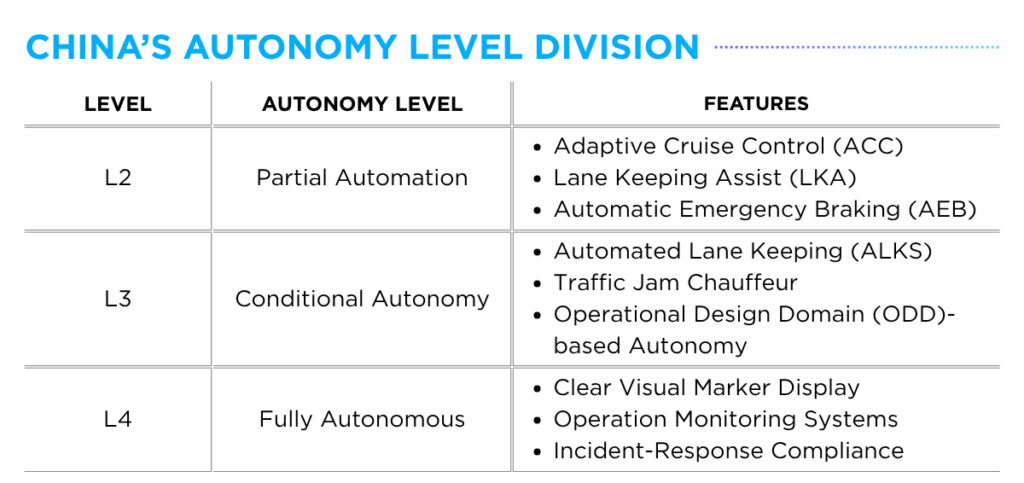
China introduced a clear commercialization pathway for OEMs targeting Level 2-4 autonomy through its national pilot program, announced in November 2023. By focusing on seamless integration between vehicles, infrastructure and cloud platforms — leveraging technologies such as Cellular Vehicle-to-Everything (C‑V2X), edge computing, and signal systems — the initiative has ensured pilot zone vehicles are equipped for safe and standardized evaluation.
Through this initiative, Chinese OEMs have made significant progress, launching their own branded ADAS platforms — DiPilot (BYD) and G-Pilot (Zeekr) — in early 2025. BYD became the first Chinese automaker to obtain a conditional Level 3 testing license in July 2023 and has since introduced Level 4 autonomous parking capabilities through its DiPilot ADAS platform. By June 2025, nine manufacturers, including Nio, Changan Automobile, and GAC, had completed preparations for public road testing of Level 3-capable vehicles.
Germany has also emerged as a regulatory leader, particularly through the Autonomous Vehicles Approval and Operation Ordinance (AFGBV) which governs the approval, registration and operation of SAE Level 4 autonomous vehicles. While the ordinance was adopted in May 2022 and came into effect in July 2022, detailed implementation guidelines published in 2024 clarified practical procedures for public transportation authorities. These documents have provided essential guidance to municipalities, transit operators and OEMs, helping shape a consistent framework for the long-term deployment of autonomous fleets.
Guideline for Operational Area Approval: Framework for municipalities and OEMs to define, assess, authorize public road areas for autonomous vehicle operation
These regulatory advances have enabled OEMs such as BMW and Mercedes-Benz to integrate automation software into their vehicle portfolios. In June 2024, BMW introduced both Level 2 (‘BMW Highway Assistant’) and Level 3 (‘BMW Personal Pilot’) systems in its 7 Series lineup, offering highway automation and conditional driver delegation capabilities. In December 2024, Mercedes-Benz received approval to increase the operating speed of its DRIVE PILOT system to 95km/h and became the first automaker in Germany authorized to use special marker lights indicating automated driving mode.
These national and international efforts collectively signal a growing global alignment in regulatory strategy and commercial deployment readiness. Structured permit systems and clearly defined liability frameworks have provided OEMs with the flexibility to develop, certify, and scale Level 3+ autonomous vehicles — a momentum that is likely to accelerate further in the coming years.
Open-Source SDV: Software-Driven Collaboration
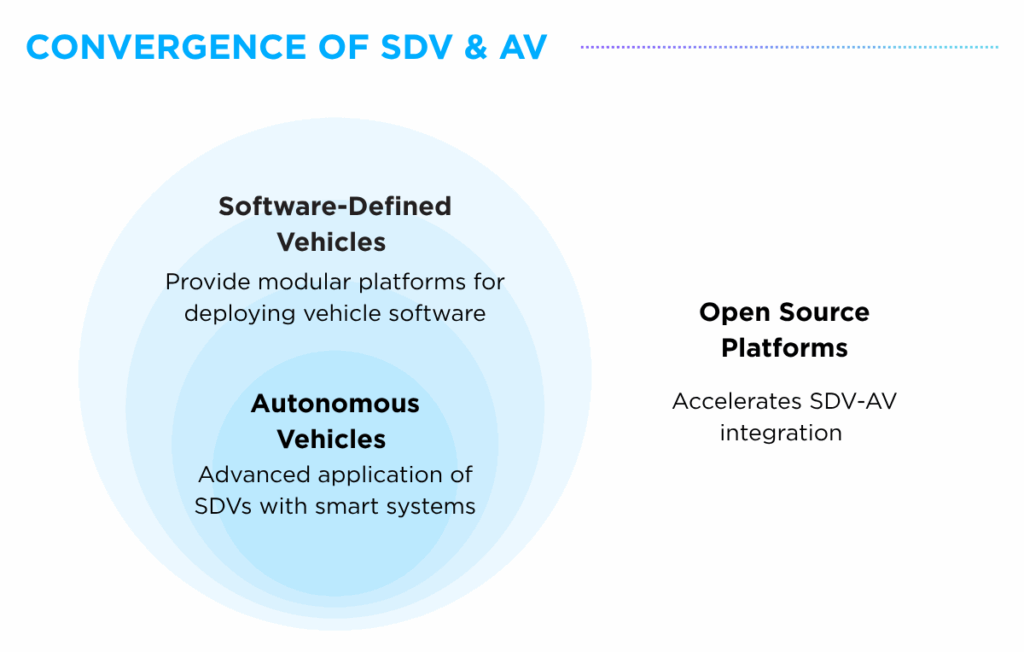
As the path to commercial autonomy becomes clearer, attention is increasingly turning to the software foundations that enable it to scale — particularly open-source software defined vehicle (SDV) projects. This shift is being shaped by the growing convergence of autonomous vehicles (AVs) and SDVs, where AVs increasingly rely on SDV architecture for modularity, real-time updates, and system integration. Open-source platforms are emerging as critical enablers of this transition by supporting scalable and collaborative development.
SDV platforms provide the technical backbone for scalable autonomy by enabling modular design, continuous over-the-air (OTA) updates, and real-time system integration. These capabilities, when delivered through accessible and interoperable open-source solutions, help overcome the fragmentation and integration challenges that often hinder large-scale AV deployment.
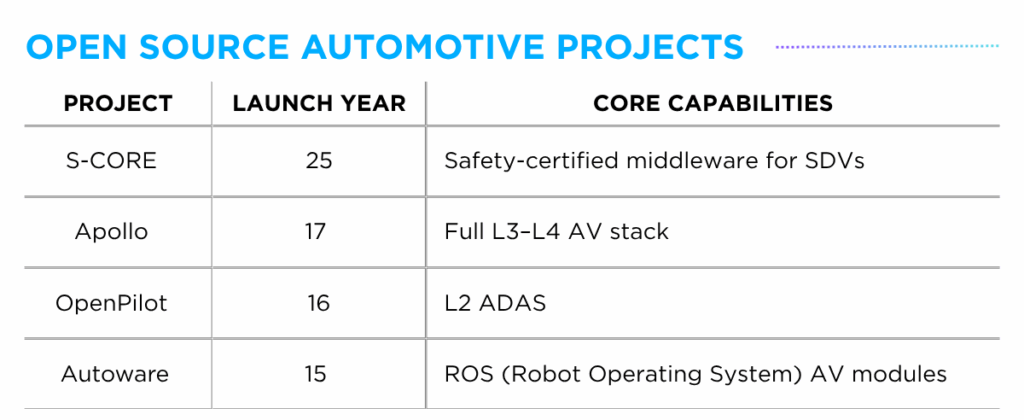
A key example of this trend is the S-CORE Project, announced in June 2025. Backed by key industry players like Bosch, QNX and Mercedes-Benz, the initiative aims to build the first open-source core stack for SDVs. The core stack is designed to standardize the middleware layer between the operating system and higher-level vehicle applications, with an emphasis on functional safety. Aligned with global regulatory standards such as ISO 26262 (functional safety), ISO/SAE 21434 (cybersecurity), and UN Regulation No. 156 (OTA Updates), the framework is OEM-agnostic and modular by design — supporting deployment across a wide range of vehicle platforms.
While it builds on a growing legacy of open-source automotive projects such as Autoware — of which AUTOCRYPT is a participating member focused on addressing security risks in real-world vehicle software — the S-CORE Project represents a meaningful shift. It moves focus from application-specific tools (e.g., AV stacks, ADAS platforms) toward foundational, certifiable infrastructure designed to support mass production of SDVs. Positioned as a “core runtime environment” for software-defined vehicles, S-CORE aims to bridge the gap between low-level system layers and OEM-specific applications, creating more room for OEMs and Tier 1 suppliers to collaborate on shared infrastructure.
Further open-source projects around software-defined vehicles are expected to emerge in the future due to economic and strategic industry alignment. With the complexity of software-defined vehicles (SDVs) increasing, it has become less viable for individual OEMs and/or suppliers to build and maintain fully proprietary software stacks. Open-source core frameworks like the S-CORE project aim to address this challenge by providing a standardized, resuable foundation which could allow companies to redirect resources toward value-added differentiation (UX, apps, mobility features).
Alignment with global regulatory standards has further elevated the role of open-source software. Standards such as UNECE R156 and R157, ISO 24089, ISO/SAE 21434 emphasize the need for secure, traceable, updateable vehicle software, better done transparently through building on open-source environments. In short, open-source projects offer a flexible and accountable framework, helping stakeholders align with evolving requirements more efficiently.
Future Implications
Regulatory and commercial developments across Levels 2 to 4 autonomy continue to mature, creating new opportunities for OEMs and Tier 1 suppliers, while steadily enhancing the autonomous driving experience for end users. This transformation is no longer confined to national borders, as open-source initiatives gain traction, driven by economic and regulatory imperatives.
As autonomous driving environments expand, so do the associated attack surfaces — from internal vehicle systems to connected external infrastructure. This underscores the growing need for continuous cybersecurity validation, including threat modeling, real-time risk monitoring and regulatory gap analysis. Positioned at the intersection of software-defined vehicle (SDV) innovation and autonomous vehicle (AV) safety,Autocrypt remains committed to supporting OEMs and Tier 1 suppliers in scaling innovation without compromising cybersecurity.
To learn more about the Autocrypt’sproducts and offerings, click here. Read our blog or subscribe to AUTOCRYPT’s newslettersfor more technology insights.