At Automotive Innovation Day (AID) 2026, AUTOCRYPT announced its partnership with Elektrobit, a leading automotive software provider, marking an important step in expanding its capabilities across the software-defined vehicle (SDV) ecosystem (Link). The significance of the collaboration extends beyond bringing together automotive software and individual cybersecurity technologies.
As vehicle functionality becomes more software-defined, software platforms are emerging as critical integration points for vehicle functions, computing environments, and cybersecurity requirements. This shift underscores the need for closer alignment between software platform development with cybersecurity engineering throughout the vehicle lifecycle.
In light of these changes, this article explores how the complementary capabilities of AUTOCRYPT and Elektrobit can contribute to closer coordination between software platforms and cybersecurity across the SDV architecture.
Evolving Cybersecurity Across SDV Architectures
The transition toward SDVs is changing not only how vehicle functions are implemented, but also the underlying architecture on which they depend. Vehicle functionality is increasingly built upon common software foundations spanning ECU software and embedded platforms, operating systems and middleware, high-performance computing (HPC), in-vehicle networking, and application environments.
As these software environments become interconnected, cybersecurity requirements also extend across multiple architectural layers. Secure communication, execution, authentication and validation depend on interactions between different parts of the software architecture, creating a series of cybersecurity intersections across the SDV architecture.
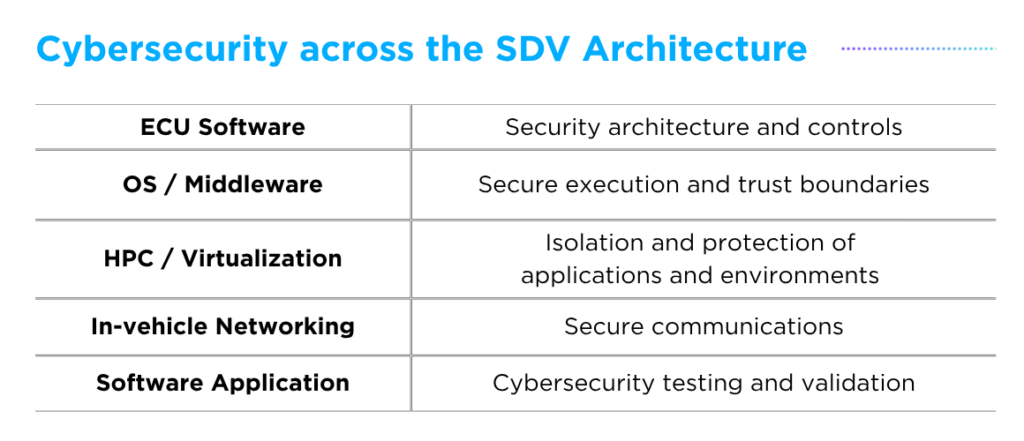
These intersections illustrate how cybersecurity requirements extend beyond individual components and environments, requiring a more aligned approach to software development and cybersecurity engineering.
Complementary Expertise for Secure SDV Development
The AUTOCRYPT · Elektrobit partnership addresses this relationship through capabilities spanning different dimensions of the SDV architecture.
- Elektrobit provides the software environments in which SDV functions are developed, integrated and operated.
- AUTOCRYPT complements these foundations with automotive cybersecurity infrastructure and engineering capabilities.
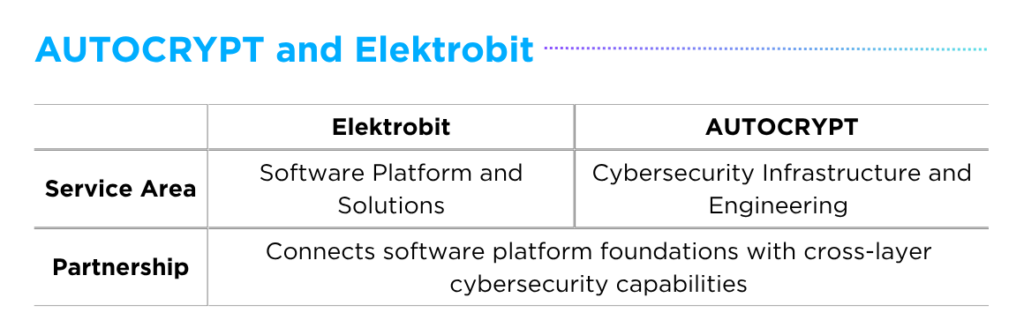
For OEMs and suppliers, bringing these capabilities closer together can create value across three key areas.
Value 1) Earlier Integration of Software & Cybersecurity
Cybersecurity requirements can be considered alongside software platform architecture from earlier stages of development, creating greater continuity between security architecture, implementation, and validation while reducing reliance on later-stage security integration.
Value 2) Reduced Integration Complexity and Fragmentation
Closer alignment between software platform development and cybersecurity engineering can help reduce fragmentation between independently developed software and security components, supporting more consistent security implementation and validation across vehicle systems.
Value 3) Support for Cross-Layer Cybersecurity
Addressing trust relationships and interactions across architectural boundaries helps extend cybersecurity beyond individual layers toward a broader relationship between software platforms and cybersecurity infrastructure.
Software Platforms for SDV Development
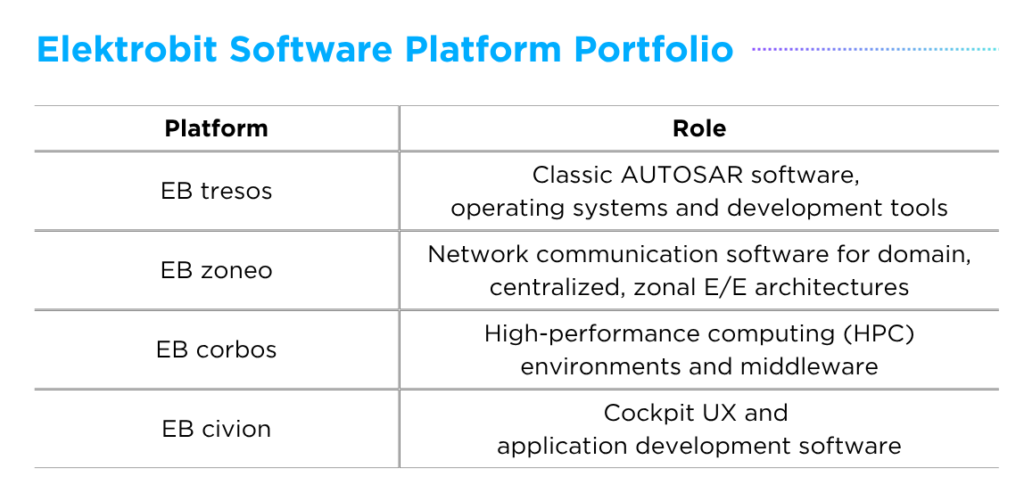
As an authorized partner for key Elektrobit software platform solutions in South Korea, AUTOCRYPT provides access to a portfolio spanning major areas of the SDV software architecture.
(1) EB tresos (Link)
EB tresos provides the embedded software foundation for developing and integrating vehicle functions within Classic AUTOSAR environments, with scalable basic software, operating systems, and development tooling.
(2) EB zoneo (Link)
EB zoneo supports domain, centralized and zonal E/E architectures, providing the communication software required to connect distributed and centralized vehicle functions across in-vehicle networks.
(3) EB corbos (Link)
EB corbos provides a comprehensive set of software building blocks for automotive high-performance computing environments, supporting technologies including Adaptive AUTOSAR, virtualization, automotive Linux.
Within the EB corbos portfolio, EB corbos Linux (Link) provides an open-source operating system foundation designed for HPC environments, while EB corbos Link (Link) provides middleware connecting Android and Android Automotive OS (AAOS) with AUTOSAR environments.
(4) EB civion (Link)
EB civion accelerates digital cockpit HMI and application development with virtualization technologies, enabling teams to create a branded user experience without relying on physical hardware.
Extending Cybersecurity Across the SDV Architecture
The shift toward software-defined vehicles is reshaping traditional boundaries between vehicle domains, creating a more interconnected software environment spanning embedded systems, centralized computing, and applications. Cybersecurity is moving beyond a discrete concern addressed at later stages of development, evolving into a cross-layer requirement that must be considered throughout the software lifecycle.
Addressing this shift requires closer coordination between the software foundations on which vehicle functions operate and the cybersecurity capabilities that extend across them. Through the complementary expertise of Elektrobit in software platforms and AUTOCRYPT in automotive cybersecurity, the partnership supports closer alignment between software development and lifecycle-oriented cybersecurity engineering.
Additional Resources
- Press Release: https://autocrypt.io/elektrobit-korea-partnership/
- Elektrobit Software Platform Portfolio