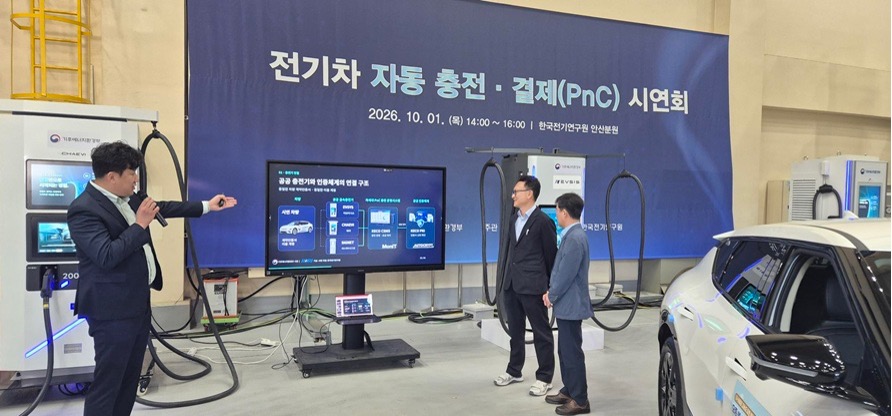
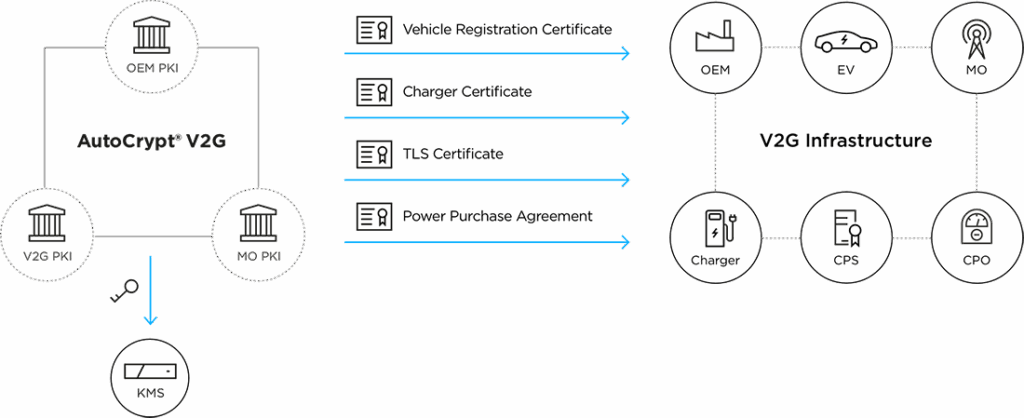
AUTOCRYPT, a leading Physical AI security solutions provider, announced that it has successfully established a Public Key Infrastructure (PKI) system for Plug&Charge (PnC) services in South Korea, enabling diverse OEMs and charging point operators (CPOs) to connect through a common authentication framework. The infrastructure was validated across electric vehicles from six global automotive brands, including Hyundai Motor, Kia, KG Mobility, BMW, Mercedes-Benz and Tesla.
Built on a public Vehicle-to-Grid (V2G) Root Certificate Authority (CA), the PKI system enables registered vehicles to automatically authenticate and charge at compatible chargers, with the potential to support future payment and settlement services. By providing a shared trust framework, it reduces the need for OEMs and CPOs to establish and manage separate authentication systems while supporting PnC deployment across diverse vehicle and charging environments.
“Scaling PnC services requires a trusted framework that securely connects vehicles, charging infrastructure, and service providers,” said Duksoo Kim, Co-Founder and CEO of AUTOCRYPT. “As we enter the Physical AI era, this trust foundation will become increasingly important in enabling secure, automated charging with minimal human intervention.”
Looking ahead, AUTOCRYPT is extending its PnC PKI infrastructure to additional OEMs and CPOs, with further PKI integrations involving global automotive partners underway.
AUTOCRYPTis a leading provider of Physical AI security solutions protecting autonomous and connected vehicles, EV charging infrastructure, robotics, defense, and bio-healthcare systems. Built on expertise in automotive cybersecurity engineering, penetration testing, security validation, and consulting, AUTOCRYPT delivers end-to-end cybersecurity across the system lifecycle. As the only designated automotive cybersecurity Technical Service (TS) provider in the Asia-Pacific region, the company supports OEMs and suppliers from vehicle development through post-production while enabling compliance with global standards. Today, the company is extending trusted security across vehicles, communications, and connected services to help shape the future of Physical AI security.
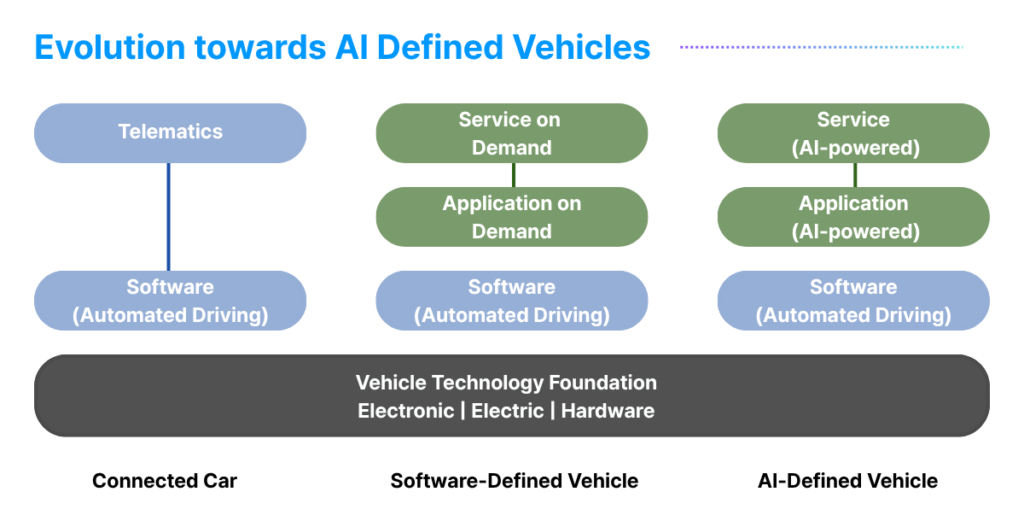
The boundaries of the vehicle are expanding as connected services, software-defined architectures, and AI-powered applications become more integrated into vehicles. This growing connectivity extends data exchange beyond the vehicle itself to cloud platforms (V2C), infrastructure (V2I), other vehicles (V2V), and connected devices.
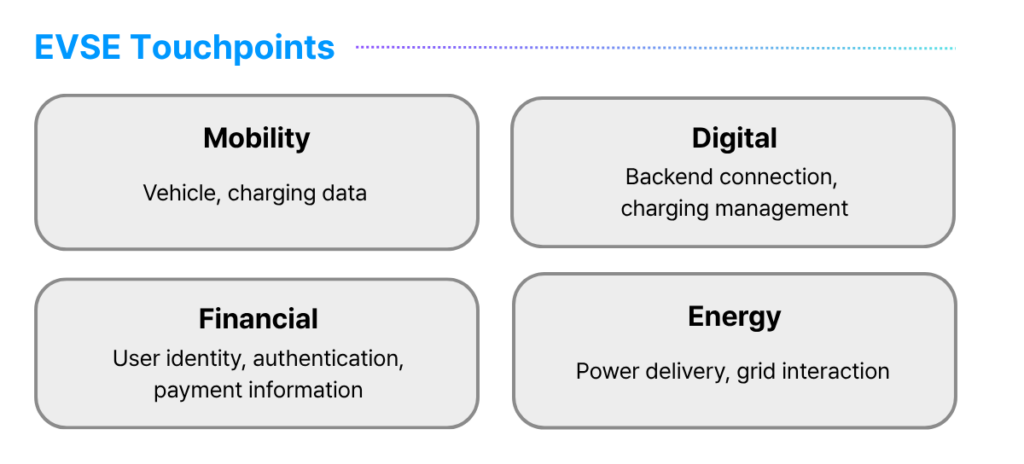
Among these connection points, EV charging infrastructure — particularly Electric Vehicle Supply Equipment (EVSE) — represents a particularly critical interface. It connects directly with the vehicle while simultaneously communicating with backend and network infrastructure, placing it at the convergence of mobility, digital, financial, and energy systems. As these systems become more closely connected, EV charging infrastructure becomes an increasingly important part of the automotive cybersecurity landscape.
This article examines how security can be established and maintained across EV charging infrastructure — from standards and certification that provide a foundation for trusted communication to an integrated approach for continuous security management.
EV Charging Infrastructure Becoming a Cybersecurity Target
Recent cybersecurity incidents across the automotive ecosystem demonstrate how growing connectivity is accompanied by an expanding cybersecurity attack surface. According to Upstream Security’s 2026 Global Automotive and Smart Mobility Cybersecurity Report (Link), 494 publicly reported automotive and smart mobility cybersecurity incidents were analyzed in 2025. Of these incidents, 71% were attributed to black hat threat actors, up from 65% in 2024, while 20% were classified as massive-scale incidents.
The findings also highlight the growing exposure of connected systems beyond the vehicle. Telematics and cloud systems accounted for 67% of attack vectors, demonstrating how external connectivity has become an increasingly significant part of the automotive threat landscape. The impact also extends beyond individual systems, with 34% resulting in service or business disruptions.
For EV charging infrastructure, these risks take on broader significance due to the multiple critical systems interconnected within the charging environment. A vulnerability at one point could potentially expose personal, authentication, or payment information, or lead to the manipulation and disruption of individual chargers and charging networks.
The same technology pathways that enable EV charging infrastructure to connect vehicles with digital services, payment systems, and energy infrastructure also introduce multiple points of cybersecurity exposure. Protecting this environment therefore requires securing not only individual components, but also the communications and interactions between them.
Establishing Trusted Communications across EV Charging Infrastructure
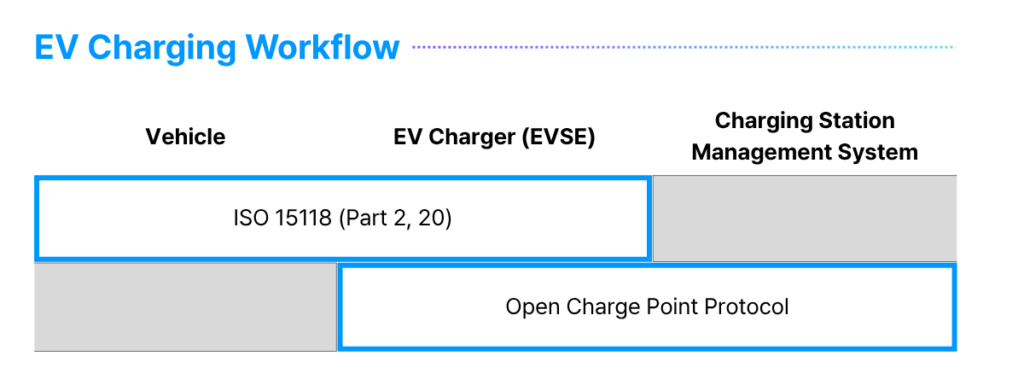
As cybersecurity risks extend across the EV charging ecosystem, secure authentication and communication are essential to interactions among vehicles, charging infrastructure, and backend systems. Two key standards support these interactions: ISO 15118 and Open Charge Point Protocol (OCPP).
ISO 15118: Communication between the electric vehicle (EV) and Electric Vehicle Supply Equipment (EVSE)
Open Charge Point Protocol (OCPP): Communication between the Electric Vehicle Supply Equipment (EVSE) and Charging Station Management System (CSMS)
The two standards address different but complementary parts of the same charging workflow, with communications touching up EV charging (EVSE) and newer OCPP versions increasing support for ISO 15118 functionality.
ISO 15118-2, ISO 15118-20
The ISO 15118 standard series defines communication between electric vehicles and EV charging equipment. A key capability enabled by the standard is Plug&Charge(PnC), which uses certification-based authentication to allow a vehicle to be automatically identified and authenticated when connected to compatible charging infrastructure.
The standard has continued to evolve alongside EV charging technologies. ISO 15118-2 (Link), published in 2014, specifies network and application protocol requirements from the Vehicle-to-Grid (V2G) communication interface. ISO 15118-20 (Link), published in 2020, expands the scope of the standard with additional charging methods and communication requirements for bidirectional power transfer, while also supporting wireless communication and automatic connection devices.
Open Charge Point Protocol (OCPP) 1.6, 2.0.1, 2.1
While ISO 15118 covers communication between the vehicle and EVSE, OCPP (Link) defines communication between the EVSE and Charging Station Management System (CSMS). This communication layer enables remote operation and management of charging infrastructure, including charging status and transaction management, remote monitoring and configuration, and device and firmware management.
OCPP has similarly evolved alongside the charging ecosystem, from OCPP 1.6, 2.0.1 and 2.1 (Link), introducing strengthened security capabilities, expanded smart charging functionality, and closer integration with ISO 15118. OCPP 2.0.1 introduced native support for ISO 15118 Plug&Charge, including certificate management and authorization, while OCPP 2.1 further extends this relationship through support for ISO 15118-20 and bidirectional power transfer.
Beyond Protocols and Certification: Importance of Operational Security
While these standards establish trusted communication across the charging workflow, deployed infrastructure remains exposed to evolving cybersecurity risks, including software vulnerabilities, malicious commands, unauthorized access, physical tampering, and unpatched software and firmware. Addressing these risks requires ongoing security management and visibility across the charging environment.
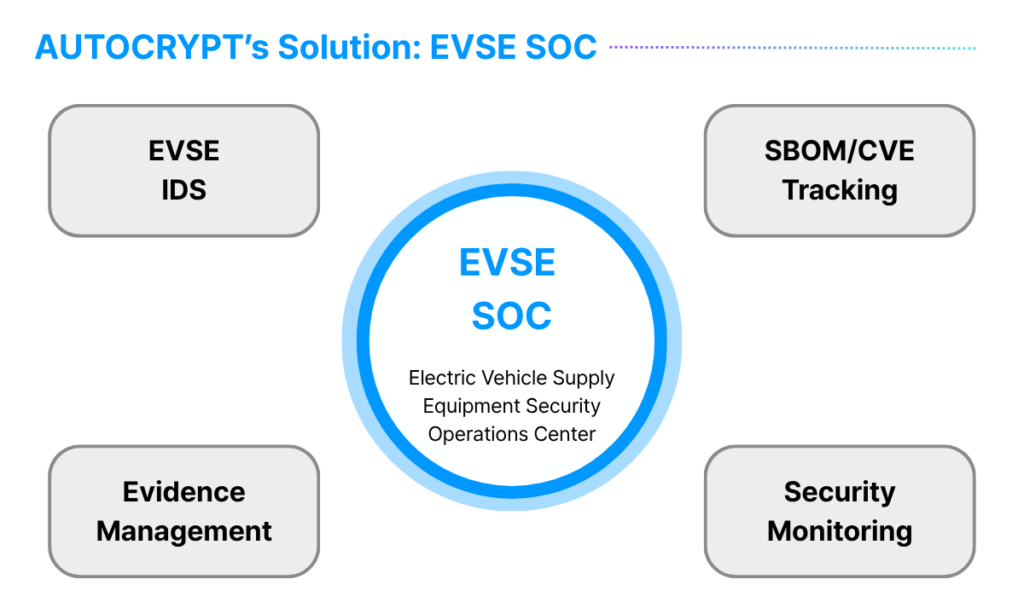
To address these operational security needs, AUTOCRYPT’s Electric Vehicle Supply Equipment Security Operations Center (EVSE SOC) (Link) brings together four security capabilities — EVSE Intrusion Detection System (IDS), SBOM/CVE Tracking, Evidence Management, and Security Monitoring — within an integrated platform for deployed EV charging environments.
(1) EVSE Intrusion Detection System (IDS)
Analyzes charger events and protocol anomalies
Detects abnormal commands and behavior
Identifies authentication failures, configuration changes, and tamper events
(2) Software Bill of Materials (SBOM), Common Vulnerabilities and Exposures (CVE) Tracking
Collects and manages SBOM, CVE information
Assesses vulnerability impact by charger model
Tracks patch status, prioritizes remediation
(3) Security Evidence Management
Collects and preserves security activity records
Maintains evidence of incidents, updates, certificate activities
Automates reporting for regulatory compliance and audits
(4) Security Monitoring
Collects and correlates security events in real-time
Monitors authentication, configuration, tamper, firmware status
Providing these four capabilities within an integrated platform, EVSE SOC extends the trust established through secure communication into continuous security management throughout operation.
Maintaining Trust Throughout the EV Charging Lifecycle
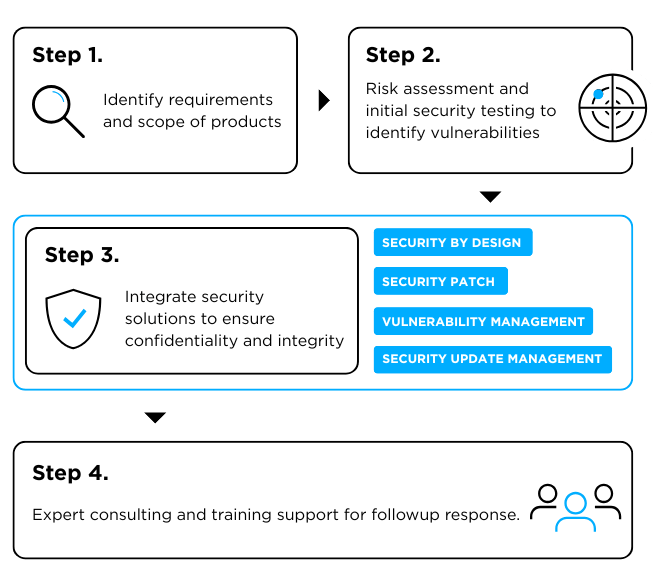
As EV charging becomes increasingly connected and bidirectional, cybersecurity must extend beyond individual vehicles and chargers to the broader infrastructure that connects them. Maintaining trust therefore requires cybersecurity to be considered throughout the EV charging lifecycle — from design and deployment to operation, monitoring, and response.
AUTOCRYPT’s EVSE SOC supports this approach by integrating threat detection, vulnerability management, security evidence, and continuous monitoring across deployed charging environments. As mobility continues to evolve toward increasingly connected and AI-driven systems, maintaining trust across the infrastructure that supports them will become an increasingly important part of automotive cybersecurity.
EV charging infrastructure sits at the center of the electric mobility transition. Yet according to theThe HERE-SBD EV Index 2025, limited charging access remains the top barrier to EV adoption, with more than half of respondents (53%)citinga perceived lack of charging access as their primary concern.
Expanding the availability of charging stations is crucial, but so is securing the digital backbone that supports them. Public charging points are no longer simple power outlets, but digital infrastructures that handle sensitive information such as personal identifiers, payment credentials and vehicle contract certificates. Without robust safeguards, these data can become points of vulnerability, slowing adoption.
This blog explores three cornerstone frameworks shaping EV charging security — ISO 15118-2 (2014), the Open Charge Point Protocol (OCPP) 2.0.1 (2020), and the EU Cyber Resilience Act (CRA) (2023).By examining their roles and how they interconnect, we aim to simplify compliance in the EV charging ecosystem and highlight how integrators like AUTOCRYPT can help turn these standards and regulations into practice.
I. Interconnected Pillars of EV Charging Security
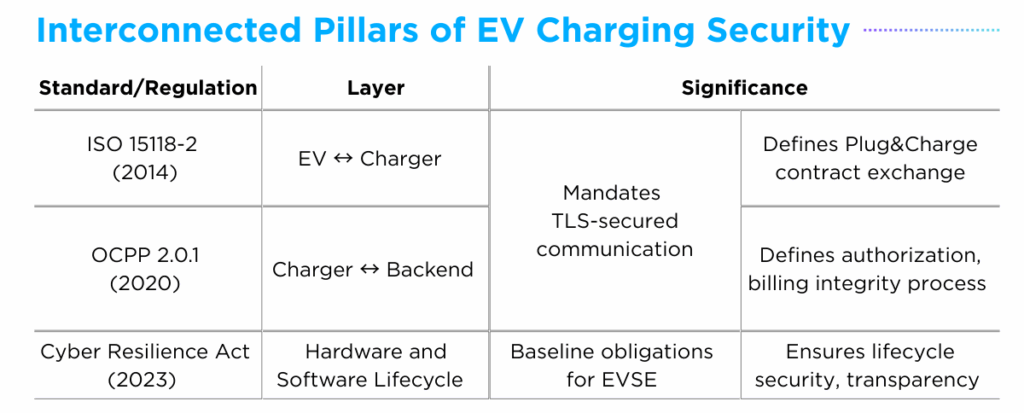
Securing EV charging infrastructure depends on three complementary pillars, each addressing a different layer of the ecosystem.
A) ISO 15118-2 (2014): Securing the EV, Charger Interface
The ISO 15118multi-part standard (i.e.Part 1 – 2013, Part 2 – 2014, Part 3 – 2015, Part 20 – 2022) defines secure, interoperable communication between the vehicle and the charging station. While each part addresses different aspects of EV-EVSE interaction,Part 2: Network and application protocol requirements is especially significant as it lays out the technical implementation for managing secure communication flows.
ISO 15118-2 (2014)mandates that EV and EVSE establish a TLS-secured channel for direct current (DC) charging using certificate-based authentication. Within this secure channel, the Plug&Charge contract exchange is executed: the EV presents its contract certificateand the charger verifies it with the backend, enabling seamless authentication and billing. Later updates in ISO 15118-20 (2022) expand these provisions to cover both alternating current (AC) and direct current (DC) charging, as well as Vehicle-to-Grid (V2G) bidirectional energy flows.
Together, these measures ensure that the EV-charger handshake is both seamless and secure, protecting against spoofing and unauthorized access.
B) Open Charge Point Protocol (OCPP) 2.0.1 (2020): Securing the Charger, Backend Interface
The Open Charge Point Protocol (OCPP) 2.0.1 provides an open, interoperable standard for communication between charging stations and backend systems such as Charging Station Management System (CSMS) and mobility operators (MO).
OCPP 2.0.1 requires charging stations and backend systems to establish a TLS 1.2-secured channel with mutual authentication. Over this protected connection, OCPP defines operational protocols ranging from standardized message formats for anomaly reporting to the use of digitally signed meter values that ensure billing accuracy.
By embedding these measures, OCPP ensures chargers remain trusted, manageable and interoperable throughout their operational life.
C) Cyber Resilience Act (CRA) (2023): Hardware and Software Lifecycle
Although the Cyber Resilience Act (CRA)does not specifically target EV charging infrastructure, it strengthens EVSE security by covering hardware, firmware and backend systems under the category of “products with digital elements.”
Under the baseline obligations of the CRA, all EVSE must be secure at launch and throughout use, with manufacturers required to conduct conformity assessments before placing products on the market. Moreover, the CRA mandates secure update mechanisms such as OTA updates, vulnerability handling processes including coordinated disclosure, and obliges manufacturers to report actively exploited vulnerabilities.
In doing so, the CRA provides the regulatory umbrella that ensures ISO 15118 and OCPP implementations are maintained securely and transparently across both hardware and software layers.
Interconnected Security Chain
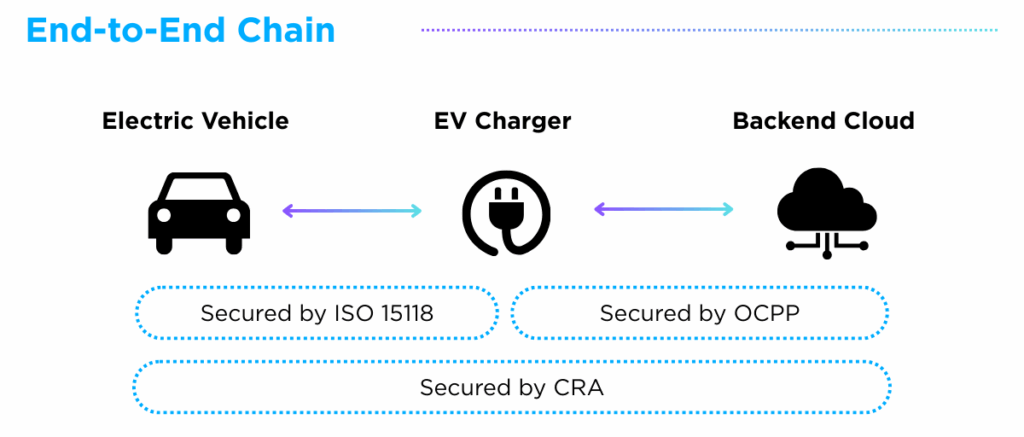
Viewed together, these three pillars create a security chain rather than isolated requirements. ISO 15118-2 secures the EV-charger interface, OCPP 2.0.1 governs charger-backend communications, and the EU Cyber Resilience Act sets mandatory cybersecurity obligations across hardware and software. Combined, they form an interconnected framework that strengthens resilience, ensures compliance, and builds trust throughout the entire EV charging ecosystem.
II. Autocryptasthe Integrator
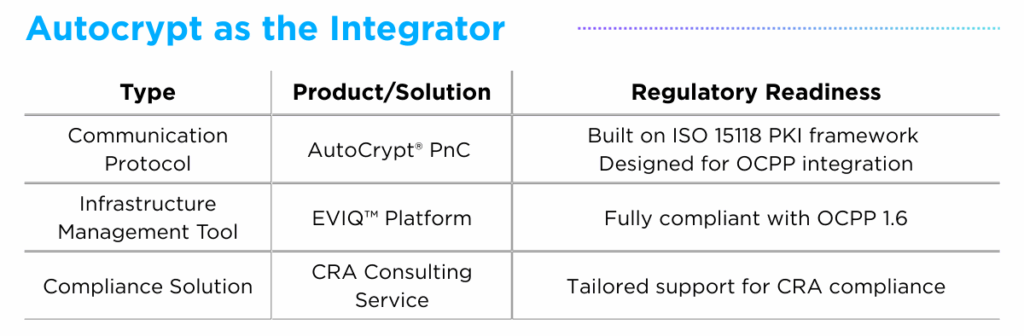
AUTOCRYPT combines a deep understanding of standards-based requirements with practical expertise to deliver a wide range of solutions for securing EV charging infrastructure. By aligning with ISO 15118 and OCPP, and offering dedicated guidance on CRA compliance, AUTOCRYPT acts as an integrator that embeds end-to-end trust across the entire EV charging chain.
A) AutoCrypt® PnC
The AutoCrypt®PnCprotocol incorporates mechanisms for both secure communication and PKI-based certificate management. Built on the ISO 15118 PKI authentication framework, it secures the vehicle-to-grid (V2G) communication interface through encryption and certificate-based trust. Moreover, designed for integration with OCPP, AutoCrypt PnC ensures contracts verified in the backend are securely delivered to the vehicle.
In doing so, it bridges front-end communication between the EV and charger with back-end contract flows, creating an unbroken chain of trust.
B) EVIQ™ Platform
Addressing the growing need for a unified and secure EV charging ecosystem, theEVIQ™ Platform combines applications, charger tools and management systems into one solution. Supporting Plug&Charge protocol outlined in ISO 15118 and fully compliant with OCPP 1.6, EVIQ provides both user-facing and operator-facing functions.
Together, these components make EVIQ a comprehensive platform which strengthens both user convenience and operator control.
By guiding clients through each step, AUTOCRYPT ensures ISO 15118 and OCPP implementations are maintained securely and transparently, offering a clear pathway to regulatory readiness well ahead of the enforcement deadline.
III. Safeguarding the EV Charging Security Chain
The pathtosecure EV chargingisnotdefinedbyasinglestandardorregulation, butbytheinterconnectedsecuritychain of ISO 15118, OCPP and the EU CyberResilienceAct. Together, theysafeguardtheEV-charger handshake, protect the charger-backend connection, and ensure the long-term resilience of hardware and software systems.
AUTOCRYPT plays a pivotal role in uniting these layers. Through solutions such as AutoCrypt® PnC, EVIQ™ Platform andCRA Consulting Service, the company translates complex standards and regulatory requirements into practical, operational security across the charging ecosystem.
As EV adoption accelerates worldwide, AUTOCRYPT remains committed to building end-to-end trust and driving sustainable growth by continually expanding its suite of solutions for EVSE manufacturers, operators and mobility providers.