AUTOCRYPT, a leading Physical AI security solutions provider, announced that its Red Team won first place at the DEF CON 34 Car Hacking Village CTF (Link), held from August 7 to 9 in Las Vegas, one of the world’s leading cybersecurity and hacking conferences. The victory marks AUTOCRYPT’s first championship since first participating in the competition in 2022, following its third-place finish last year.
Competing against 83 teams, AUTOCRYPT became the first team to complete all challenges, securing first place within 25 hours of the 50-hour competition. The championship further demonstrates AUTOCRYPT’s automotive cybersecurity expertise and technical capabilities on the global stage.
Held at DEF CON since 2015, the Car Hacking Village CTF is an international hacking competition focused on automotive cybersecurity. The competition tests practical automotive hacking and cybersecurity capabilities through security challenges involving real-world automotive environments, ranging from electronic control units (ECUs) and embedded boards to actual vehicles.
Leveraging its proprietary AI-powered security analysis platform, AUTOCRYPT’s security researchers utilized multiple AI agents to simultaneously identify vulnerabilities and analyze potential attack vectors, while reviewing the findings and determining the next course of action. This human-AI collaboration combines AI’s ability to rapidly process large volumes of information with the experience and judgment of security researchers.
“Winning the Car Hacking Village CTF reflects our cybersecurity expertise and hands-on experience across cryptography and vehicle environments,” said Duksoo Kim, Cofounder and CEO of AUTOCRYPT. “As the cybersecurity landscape increasingly incorporates autonomous AI agents, this achievement demonstrates how we can effectively combine AI-driven analysis with expert judgement, a pivotal approach in today’s evolving threat landscape.”
Moving forward, AUTOCRYPT plans to further advance its human-AI collaborative capabilities for application across customer-facing security services, including vehicle vulnerability assessment and penetration testing, helping customers identify and respond to emerging threats faster.
AUTOCRYPTis a leading provider of Physical AI security solutions protecting autonomous and connected vehicles, EV charging infrastructure, robotics, defense, and bio-healthcare systems. Built on expertise in automotive cybersecurity engineering, penetration testing, security validation, and consulting, AUTOCRYPT delivers end-to-end cybersecurity across the system lifecycle. As the only designated automotive cybersecurity Technical Service (TS) provider in the Asia-Pacific region, the company supports OEMs and suppliers from vehicle development through post-production while enabling compliance with global standards. Today, the company is extending trusted security across vehicles, communications, and connected services to help shape the future of Physical AI security.
As we enter an era increasingly populated by highly autonomous vehicles, there is a vast range of dynamic driving scenarios that Automated Driving Systems (ADS) may encounter. From hazardous environmental conditions to internal system failures and external cybersecurity risks, ensuring ADS safety across diverse operating situations is essential for enabling safe autonomous driving experiences.
The recent release of “ISO 34505: 2025”underscores this need by providing a structured framework for generating, evaluating and managing test scenarios that reflect real world driving conditions. By standardizing how test scenarios should be defined and tested, the initiative aims to enable consistent, repeatable validation practices across the industry and thereby support development of robust ADS provision.
As autonomous systems grow more complex, the need for robust, scalable validation practices become increasingly critical. In response, an integrated approach — combining regulatory audits, system-level testing and adversarial simulations — provides OEMs and Tier 1 suppliers a structured path for both vehicle safety and regulatory compliance. Focusing on cybersecurity, this blog outlines the key components and methodologies of ADS Validation, and demonstrates how an integrated approach can be effectively executed.
Automated Driving System (ADS) Validation: Approach & Methodology
According to “SAE J3016: 2021”, Autonomous Driving System (ADS) refer to thecollective technology stack responsible for performing dynamic driving tasks (DDT) at SAE Level3 and above. With the system taking full responsibility for autonomous decision-making and vehicle control, validating ADS safety calls for identifying diverse validation targets and a multidisciplinary process for executing them.
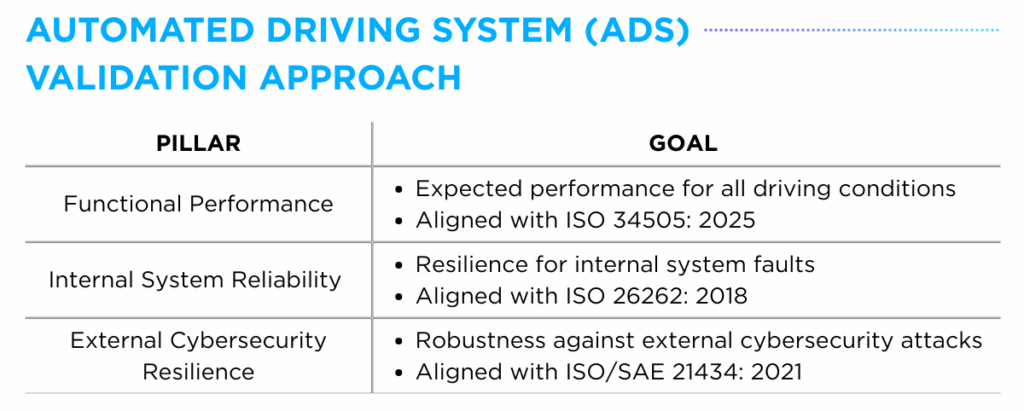
The first pillar, Functional Performance, focuses on ensuring theembedded vehicle system behaves as expected across a full range ofdriving conditions — particularly under abnormal scenarios such as complex environments or sensor limitations.In alignment with the“ISO 34505: 2025” standard, which outlines scenario-based ADS testing, this pillarevaluates system capabilities in perception, decision making and control execution under realistic conditions.
The second pillar,Internal System Reliability, addresses resilience against system-levelfaults. This includes the inspection offault detection mechanisms, hardware failure mitigation strategies, and adherence withAutomotive Safety Integrity Level (ASIL) grades. Relevant to the “ISO 26262: 2018” standard defining the framework around electrical/electronic (E/E) system failures, this pillar assesses the system’s ability to maintain safety in the presence of internal malfunctions.
The third factor, External Cybersecurity Resilience, evaluates the system’s tolerance against external cybersecurity threats. Verification over secure communication and data integrityunder potential attackssuch as vehicle hacking, spoofing and denial-of-service (DoS)) is a key objective of this pillar. Associated with the “ISO/SAE 21434: 2021” standard illustrating cybersecurity risk management for vehicle E/E systems across the lifecycle, this phase assesses the system’s ability to proactivelymitigate attack vectors targeting sensors, ECUs and OTA updates.
II. Techniques
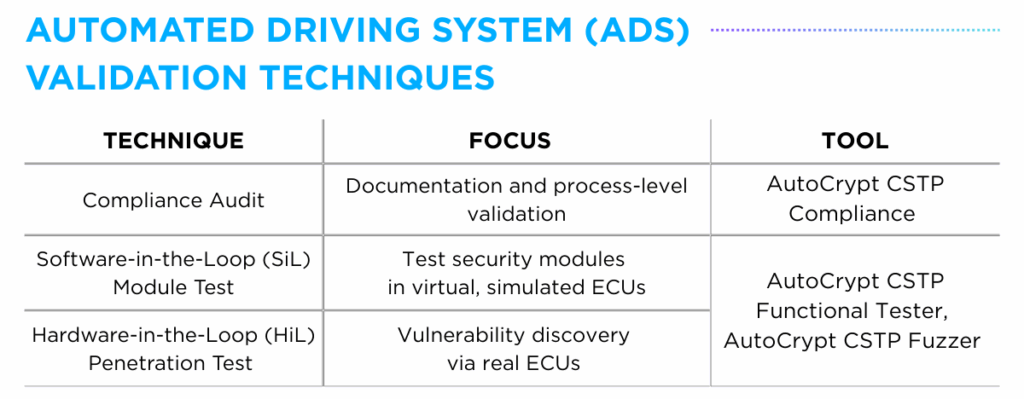
While various techniques exist to evaluate functional performance, system reliabilityand external attack resilience, this blog focuses on three core cybersecurity validation methods — Compliance Auditing, Software-in-the-Loop (SiL) Module Testing, Hardware-in-the-Loop (HiL) Penetration Testing — to better illustrate the differences across diverse validation approaches.
The first technique, Compliance Auditing, focuses on verifying whether development practices and system architectures align with established safety and cybersecurity regulations (e.g. ISO/SAE 21434, UN R155). This method is widely used by OEMs and Tier 1 suppliersto conduct gap analyses during early-development stages or in preparation for CSMS Certification audits, to check whether internal processes conform to regulatory requirements.
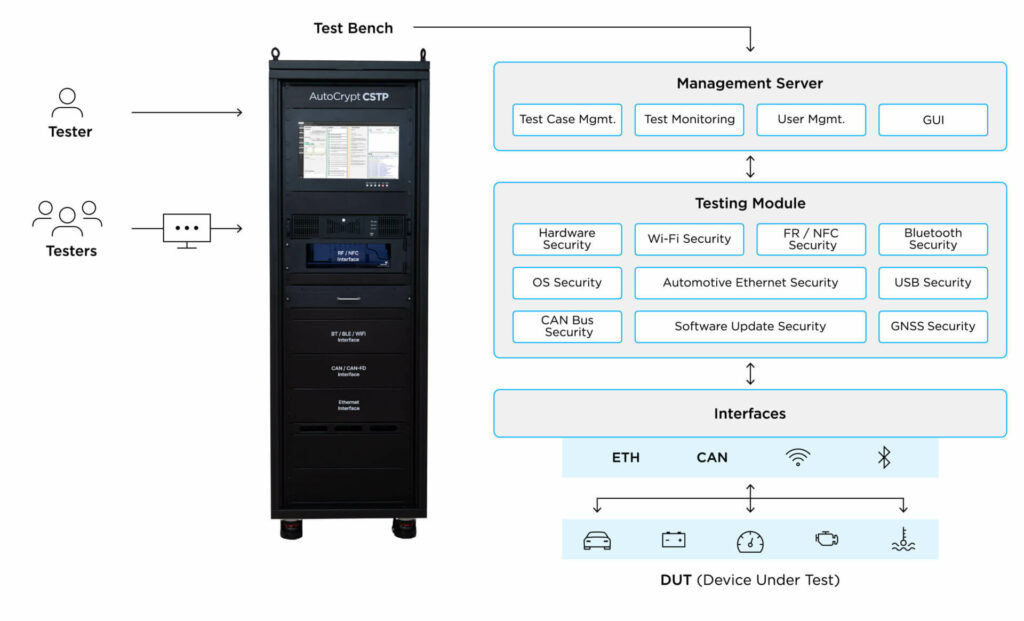
AutoCrypt CSTP Complianceserves as a representative tool to accommodate these needs by validating vehicle vulnerabilities on a unified platform. It supports multiple testing domains including Security Validation, Functional Testing, Penetration Testing, Fuzz Testing and Vulnerability Testing and consolidates results into a comprehensive reportsuitable for regulatory submission.By combining testing execution and documentation, it reduces redundant tasks and streamlines the compliance process.
Another key validation technique is Software-in-the-Loop (SiL) Module Testing, which assesses robustness of embedded security components in virtualized test environments before hardware integration. Commonly applied to TEE (Trusted Execution Environment) based key management testing and V2X certificate handling simulation, this technique enables rapid iteration and early validation of security logic in controlled conditions, before advancing to high-cost hardware testing.
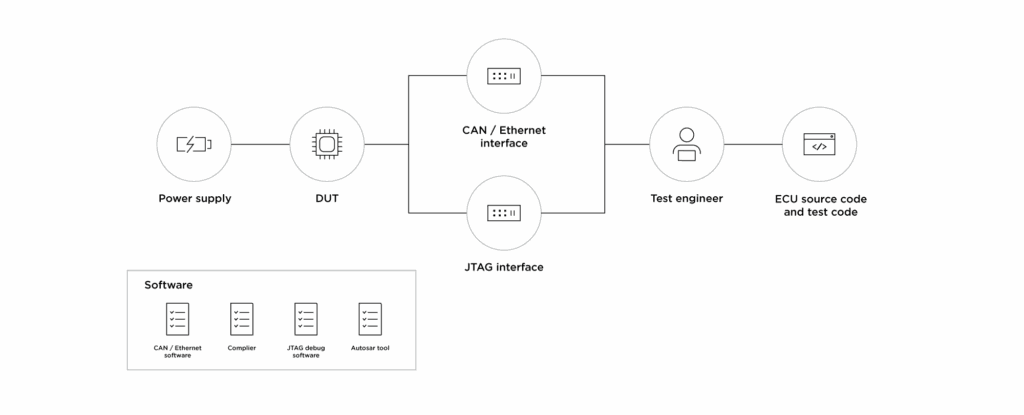
In accordance with these needs, the AutoCrypt CSTP Functional Tester validates hardware-dependent security functions using virtual ECU models in a Software-in-the-Loop (SiL) environment. By integrating communication interfaces, debugging tools, ECU source code and test code, this solution facilitates early detection of design flaws and integration issues well before mass production.
Another core testing approach is Hardware-in-the-Loop (HiL) Penetration Testing,which evaluates cybersecurity resilience of physical ECUs by simulating real-world attack vectors in controlled HiL testing environments. Often applied for in-vehicle network fuzz testing and Telematics Control Units (TCUs) penetration testing, this technique identifies system vulnerabilities under actual runtime configurations, moving beyond theoretical scenarios.
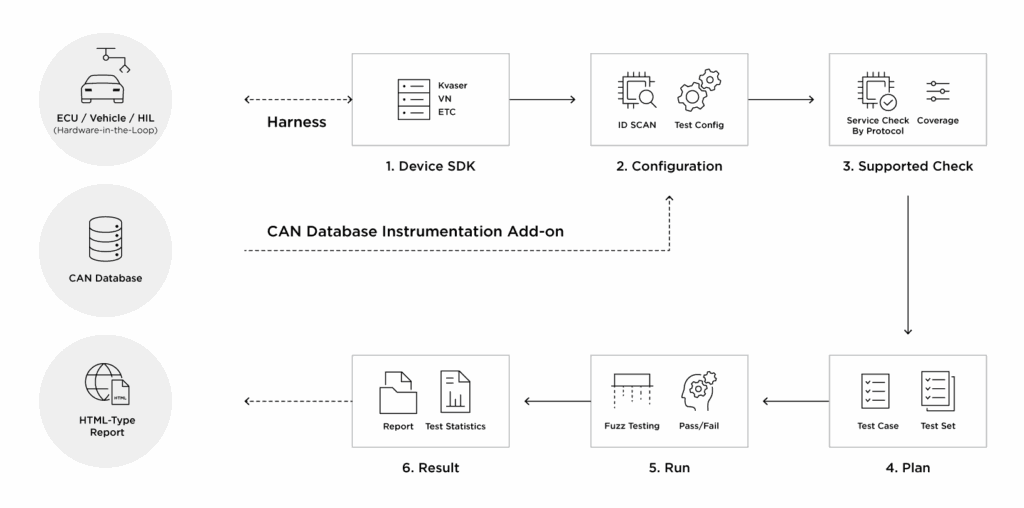
Serving this purpose, the AutoCrypt CSTP Fuzzer solution actively injects malformed, unexpected inputs into in-vehicle networks to test ECU-level resistance to cyber intrusions. Coveringa broad spectrum of communication layers including theNetwork Layer (e.g. CAN, CAN-FD, Automotive Ethernet), Application Layer (e.g. UDSonCAN, UDSonCAN-FD) and Transport/Data Layer (e.g. VehicleCAN, VehicleCAN-FD), the tool enablesprecise testing of vehicle systems under a wide range of adversarial conditions.
Effective ADS Validation through an Integrated Approach
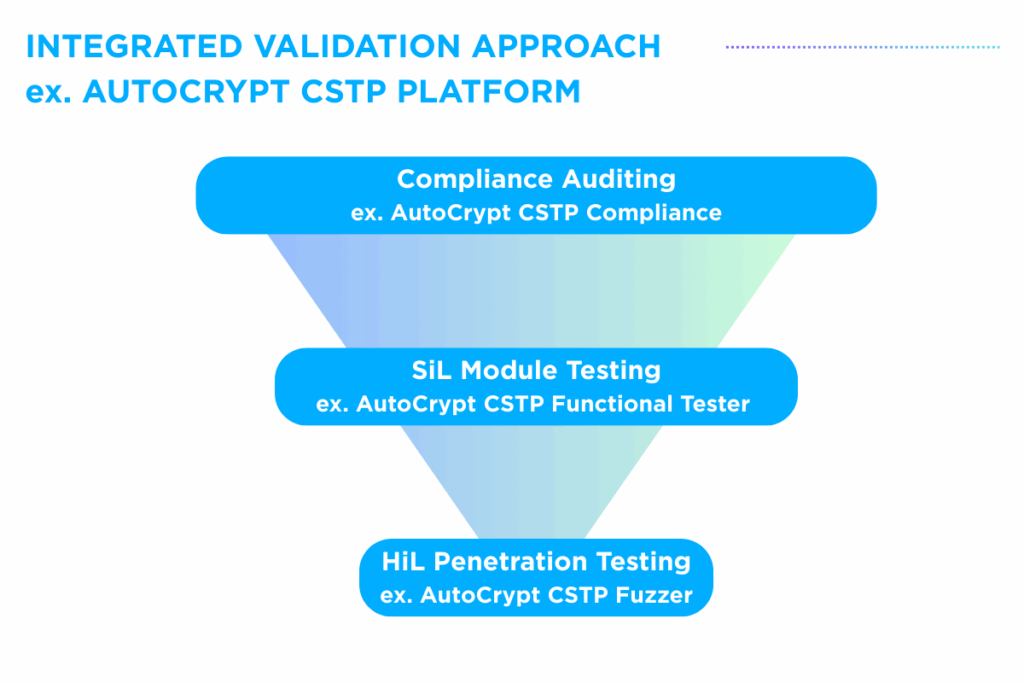
With a wide range of checkpoints to address and multiple techniques available, establishing a cohesive and effective strategy for ADS validation is essential. To meet this need, a structured progression — fromCompliance Auditing to Software-in-the loop Testing and finally to Penetration Testing — offers a practical pathway for comprehensive and efficient ADS validation.
At the first stage, Compliance Auditingdefines the baseline and sets the strategic direction through regulatory compliance and process control.
Next, software design implementation and testing activities are supported through Software-in-the-Loop (SiL) Module Testing, which enables validation before hardware integration.
Lastly, Hardware-in-the-Loop (HiL) Penetration Testing technique can be utilized to observe real-world cybersecurity readiness under adversarial conditions.
This layered approach demonstrates how each phase builds upon and reinforces the next, enabling a robust and scalable validation framework.
With AUTOCRYPT being an authorized Vehicle Type Approval (VTA) Technical Service (TS) Provider , the firm is uniquely positioned to integrate diverse testing techniques and facilitate comprehensive ADS validation through the AutoCrypt CSTP Platform. From the AutoCrypt CSTP Compliance, which ensures design-level safety, to the AutoCrypt CTSP Functional Tester, which verifies correct functional behavior and the AutoCrypt CSTP Fuzzer able to test attack resilience, the platform enables a unified security analysis by consolidating all validation layers into a single, integrated platform.
Supporting a streamlined process for Vehicle Type Approval fromADS validation to export of results into compliance documents (e.g. TARA Report, Cybersecurity Test Report), the whole approval process can be effectively managed.
To learn more about the Autocrypt CSTP platform, check this page. For more information about our comprehensive suite of our automotive products & offerings, check this page.