On June 24, 2026, the international regulatory landscape for autonomous driving reached a historic milestone when the World Forum for Harmonization of Vehicle Regulations (WP.29) formally adopted the United Nations Global Technical Regulation (UN GTR) on Automated Driving Systems (ADS) during its 199th session in Geneva (Link). Approved by a vote of contracting parties, the regulation establishes the world’s first globally harmonized technical framework for Automated Driving Systems (ADS), including vehicles capable of operating without a fallback user.
This article examines the evolution of the new framework through the official proposal documents for the UN GTR (ECE/TRANS/WP.29/2026/139) (Link) and the parallel UN Regulation (ECE/TRANS/WP.29/2026/137) (Link). It explores the decade-long journey to adoption, the regulation’s core technical requirements, and the broader implications for manufacturers, suppliers, regulators, and certification bodies as autonomous driving enters a new phase of global governance.
A Decade in the Making
The adoption of the ADS regulation represents the culmination of more than a decade of international collaboration. Rather than emerging from a single regulatory initiative, the framework reflects the convergence of technical, regulatory, and validation expertise into a single internationally harmonized standard.
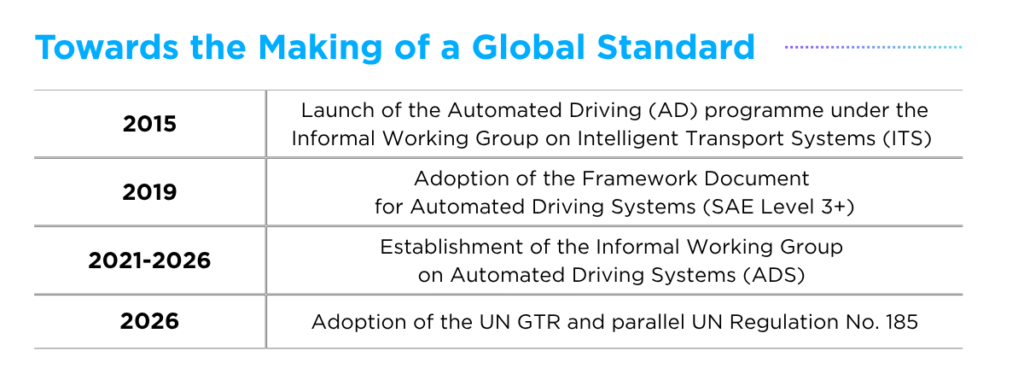
The foundation for today’s regulation was established in 2015, when WP.29 launched its Automated Driving (AD) programme (Link) under the Informal Working Group on Intelligent Transport Systems (ITS). As autonomous driving technologies matured, the initiative evolved from defining core concepts to developing internationally harmonized safety principles.
A major milestone came in 2019, when the Framework Document on Automated/Autonomous Vehicles (ECE/TRANS/WP.29/2019/34/Rev.2) (Link) established the safety foundations for SAE Level 3 and above, dividing development into two complementary workstreams: Functional Requirements for Automated Vehicles (FRAV) and Validation Methods for Automated Driving (VMAD).
Between 2021 and 2026, these efforts converged through the development of the New Assessment/Test Method (NATM) (Link) and the formal establishment of the Informal Working Group (IWG) on Automated Driving Systems (ADS). This marked an important step toward integrating functional requirements, validation methodologies, and regulatory provisions into a comprehensive regulatory framework.
Following WP.29 GRVA’s adoption of the parallel UN Regulation in January 2026 (Link) and the resolution of remaining technical issues through international consultations, WP.29 formally adopted both the UN Global Technical Regulation on Automated Driving Systems (Link) and UN Regulation No. 185 (Link) during its 199th session, marking the world’s first globally harmonized technical framework for Automated Driving Systems.
Technical Foundations of the Framework
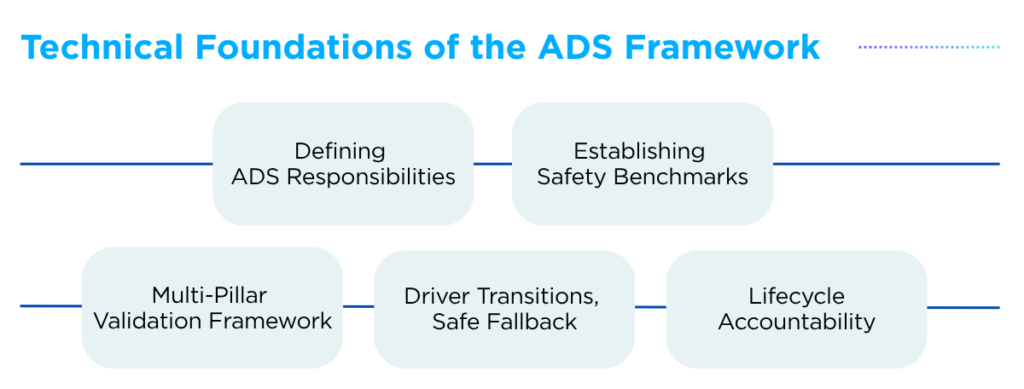
The UN GTR establishes a comprehensive technical framework to ensure that Automated Driving Systems (ADS) operate at a level of safety at least equivalent to that of a competent human driver. Rather than prescribing specific technologies, it defines the functional responsibilities, validation methods, and lifecycle requirements that manufacturers must demonstrate before deploying fully autonomous vehicles.
Defining ADS Responsibilities
A fundamental element of the regulation is the clear allocation of responsibility between an Automated Driving System (ADS) and the Dynamic Driving Task (DDT). The UN GTR defines an ADS as “the collective hardware and software capable of continuously performing the entire Dynamic Driving Task (DDT),” establishing it as the entity responsible for executing the vehicle’s driving functions. Accordingly, the ADS assumes continuous responsibility for perception, decision-making, planning, and vehicle control, whereas higher-level functions such as destination selection and route planning remain outside the scope of the DDT.
Establishing Safety Benchmarks
Building upon this allocation of responsibility, the regulation adopts a performance-based safety objective rather than prescribing how autonomous driving systems should be engineered. Within its defined Operational Design Domain (ODD), an ADS must achieve a level of safety at least equivalent to that of a competent human driver by preventing reasonably foreseeable and preventable fatalities or injuries.
Multi-Pillar Validation Framework
Recognizing that no single testing method can sufficiently demonstrate this level of safety, the regulation requires a multi-pillar validation framework known as the New Assessment/Test Method (NATM). The framework combines complementary sources of evidence — including virtual simulation, proving ground testing, public road testing, and technical assessments — to evaluate system performance across a broad range of operating scenarios and demonstrate that safety requirements have been consistently satisfied.
Managing Driver Transitions and Safe Fallback
Beyond validating system performance, the regulation also defines how responsibility should be managed during vehicle operation. It distinguishes between ADSF-1, which requires a fallback user to resume control when requested, and ADSF-2, which is designed to operate without requiring a fallback user. For ADSF-1, the system must verify the fallback user’s readiness before transferring control to prevent mode confusion. If no fallback user is available or if the user fails to respond, the vehicle must automatically transition to a Mitigated Risk Condition (MRC), bringing itself to a safe and controlled state.
Strengthening Lifecycle Accountability
Extending accountability beyond vehicle operation, the regulation introduces the Data Storage System for Automated Driving (DSSAD) to record operational data surrounding safety-related events, supporting post-incident analysis, regulatory oversight, and traceability throughout the vehicle lifecycle. It further recognizes cybersecurity as a lifecycle responsibility while remaining consistent with the cybersecurity principles established under UN Regulation No. 155 (CSMS) (Link) and UN Regulation No. 156 (SUMS) (Link).
Strategic Implications for the Mobility Industry
Beyond establishing technical requirements, the UN GTR provides strategic direction for the future development, validation, and governance of autonomous driving systems by advancing regulatory harmonization, shaping AI governance, and enabling continuous safety assurance throughout the vehicle lifecycle.
Advancing Global Regulatory Harmonization
The UN GTR reduces regulatory fragmentation by establishing a common set of technical requirements that contracting parties can incorporate into their domestic frameworks. It also marks one of the first instances in UNECE history that a Global Technical Regulation and a parallel UN Regulation have been developed simultaneously around a shared safety objective. This establishes a common regulatory foundation that supports more consistent implementation of autonomous driving technologies across international markets.
One Technical Standard, Two Regulatory Pathways
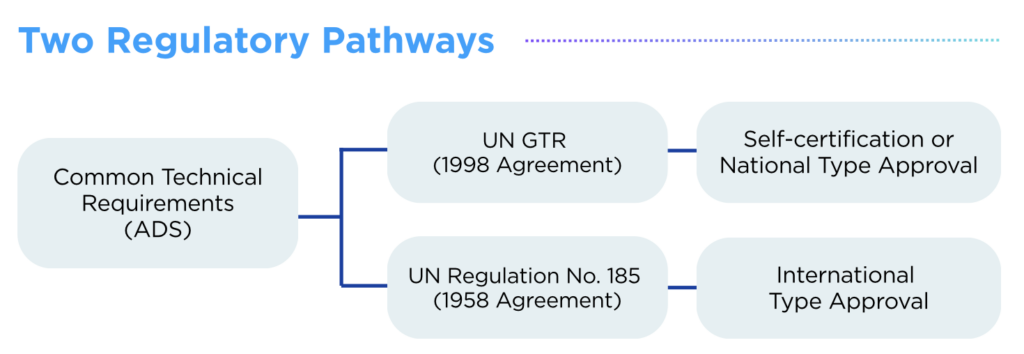
To support global adoption, the framework delivers a common set of technical requirements through two complementary regulatory pathways. Under the 1998 Agreement, the UN GTR provides a performance-based technical framework that contracting parties incorporate into their domestic legislation, allowing implementation through either self-certification or national type approval systems. In parallel, UN Regulation No. 185, adopted under the 1958 Agreement, enables international type approval with mutual recognition among contracting parties while applying the same technical requirements.
Enabling Continuous Safety Assurance
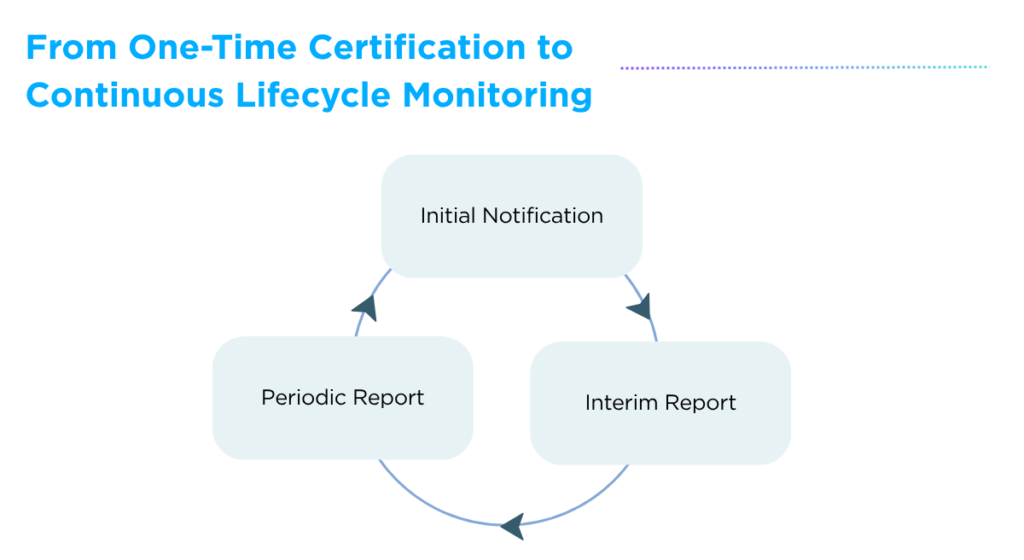
The framework ultimately extends the concept of safety beyond vehicle performance alone. By integrating harmonized technical requirements, standardized validation methods, lifecycle monitoring, it establishes a transparent basis for demonstrating the safety and reliability of autonomous driving systems. Consequently, future conformity assessment will increasingly depend on capabilities such as process auditing, simulation credibility evaluation, Safety Case assessment, and operational validation, strengthening both regulatory confidence and public trust in autonomous mobility.
Conclusion
The adoption of the UN Global Technical Regulation (GTR) for Automated Driving Systems (ADS) marks more than the introduction of another vehicle regulation. It establishes the world’s first globally harmonized framework for designing, validating, and monitoring fully autonomous vehicles throughout their operational lifecycle, providing a common foundation for the safe deployment of autonomous mobility.
As contracting parties begin incorporating the framework into national legislation, manufacturers, suppliers, and certification bodies must adapt their engineering processes, validation strategies, and lifecycle governance to meet evolving regulatory expectations. Organizations that embrace this lifecycle approach will be best positioned to accelerate the safe and scalable deployment of autonomous mobility.
Additional Resources
- UNECE WP.29 Consulting Services: https://autocrypt.io/services/wp-29/
- Products and Offerings: https://autocrypt.io/all-products-and-offerings/