How Do Vehicles Connect to the Internet and Why Would Someone Hack Them?

It has only been a little more than a decade since the introduction of the smartphone, yet they have now replaced laptops and desktops as the primary personal computing device. As we become so used to being connected to the Internet anytime and anywhere, more and more “things” now come equipped with such connectivity. One of the most common Internet of Things (IoT) devices are vehicles, but what happens when vehicles connect to each other and infrastructure?

How does vehicle connectivity work?

Most new cars in 2020 come with either embedded (built-in) or tethered (brought-in) internet connectivity, or a mixture of both. Vehicles with embedded connectivity are equipped with a built-in modem to directly receive cellular data, while those with tethered connectivity borrow the driver’s smartphone data to access the Internet (similar to WI-FI hotspots).

Most automakers offer embedded connectivity free trials for a few months, after which the driver would need to pay for continued internet access. This works similarly to a smartphone plan. For instance, AT&Tprovides a connected car data plan at cost per month for coverage in the US and Canada.

Some automakers offer embedded connectivity only for critical functions such as remote control and crash notification, and require tethered internet for all other entertainment purposes.

Whether having embedded or tethered internet connectivity, connected vehicles bring a lot of convenience and joy to the drivers. They have remote control features that allow users to unlock the doors, turn on the engine, and adjust the in-vehicle environment via their smartphone. They allow users to listen to the news, search for information, and access their smartphone all through voice control. In addition, they provide high definition streaming media content for both drivers and passengers.

Why hack a connected vehicle?

Wherever there exists an internet connection, there are security threats. The cyberthreats a connected vehicle system faces are very similar to that of a traditional IT system, in which almost all threat actors are driven by financial or political motives. In the context of a traditional IT system, the three most common objectives of cyberattacks are:

1) to exfiltrate or encrypt data for financial gains (by using the data for phishing and identity theft, selling the data to third parties, or demanding a ransom),

2) to steal intellectual property from adversaries (either businesses or political units), and

3) to disrupt operations and activities of adversaries (either businesses or political units).

In contrast, let us take a look at the most common objectives for someone to attack a car:

Vehicle theft

Believe it or not, vehicle thefts are still common. Over 150,000 vehicles were stolen in California alone in 2018 according to the Insurance Information Institute. Connected cars with smart or digital keys might decrease the chance of theft from unskilled thieves, but could as well increase the chance of theft from high-skilled hackers.

Personal data theft

Connected vehicles collect and store tons of personal data. At the very least, they store the driver’s contact list, call history, calendar, search history, entertainment preferences, driving history, and location data. Some might even store financial information for automatic payment of toll fees and EV charging fees. Attackers who gain the data may use them for identity theft, sell them to third parties, or blackmail the car owner for ransoms.

Personal attack or terrorism

This is perhaps the most concerning risk involving connected vehicles. When used abusively, cars have the potential to cause serious physical damage and death. When a threat actor hacks the system and takes full control of a car, the car becomes a destructive weapon that can be used to target specific individuals or the general public. What’s worse is that such a crime would be very difficult and expensive to solve as cybercriminals are much harder to catch.

Notice that under the third objective, a so-called cyberattack has crossed the line of cyberspace to threaten our physical safety. This has always been the biggest concern of autonomous driving. To prevent criminal groups and terrorists from destroying our transportation system, governments must work with industry experts to establish a complete international regulatory compliance for vehicle security.

In a traditional IT system, we create the network, then secure it. In a connected car system, we secure first, then ride. Having an unsecured car network is essentially the same as having a bridge built with substandard materials. This is why it is critical for us to understand where the weaknesses come from and protect them accordingly. To read more on the specific threats modern vehicles face, click here.
AUTOCRYPT Officially Joins 5GAA (5G Automotive Association) as an ITS Security Expert

SEOUL, South Korea — AUTOCRYPT, South Korea’s pioneer in security operations for C-ITS highways, its first testbed, and licensing facility autonomous vehicles joined the 5G Automotive Association (5GAA). 5GAA is a global, cross-industry organization of companies from the automotive technology and telecommunications industries (ICT) to develop 5G-based intelligent transport services and end-to-end solutions for future mobility and transportation services. The Association, founded in 2016, unites a large member base including 8 founding members which are AUDI AG, BMW Group, Daimler AG, Ericsson, Huawei, Intel, Nokia, and Qualcomm Incorporated. The members are committed to defining, developing the next generation of connected mobility and automated vehicle solutions, and testing integration into smart cities and intelligent transportation. 

By taking a big step with the members of the 5GAA towards making transportation safer, greener, and more enjoyable, AUTOCRYPT is ready for the development of road safety and prioritization of C-ITS technology. With its Key Management features, AUTOCRYPT offers an extensive suite of security solutions to solve vulnerabilities across connected and autonomous vehicle environments. The Public Key Infrastructure (PKI) and Vehicle-to-Anything (V2X) components provide essential certificate management and encryption across smart road environments, from back-end server infrastructure to endpoints. These security solutions will further develop C-ITS and the provision of V2X, V2X communications, and connected mobility solutions collectively. 

“What’s most important in the autonomous driving environment is the technologies that can guarantee the safety of communications between intelligent transport services,” said Daniel ES Kim, CEO of AUTOCRYPT. “We believe 5GAA and AUTOCRYPT together can play an enormous role in the development of 5G-V2X, which will eventually ease the global rollout of connected mobility and automated vehicles.” 

Recent milestones of 5GAA include running joint C-V2X demonstrations and launching testing events in Europe, supporting and addressing the importance of V2X and its requirements. It also aims to accelerate various development projects that lead to integrated solutions and deployments across Europe, the United States, and Asia. 

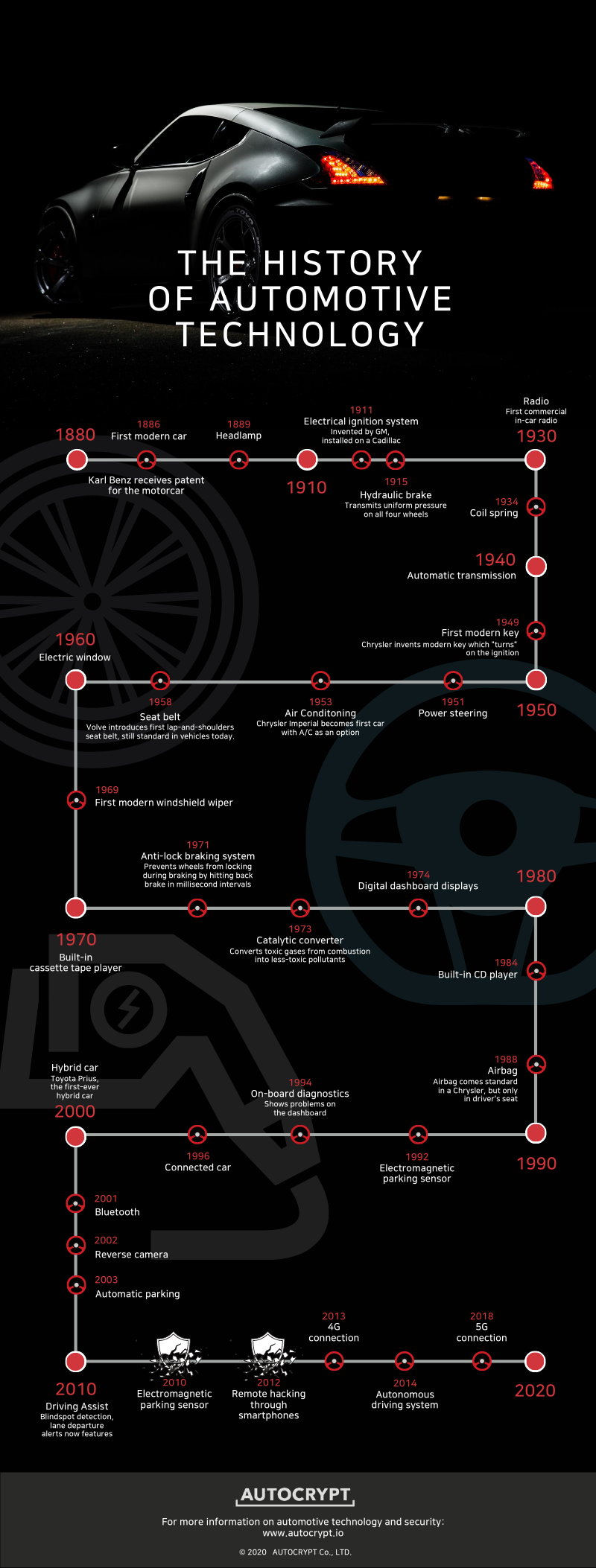
Infographic: The History of Automotive Technology

Have a look at how automotive technology has evolved throughout the history of automobiles.

(Accessibility version below)

history of automotive technology

The History of Automotive Technology

1886 – The first modern car / Karl Benz receives patent for the motorcar
1889 – Headlamp
1911 – Electrical ignition system is invented by GM and installed on a Cadillac
1915 – Hydraulic brake. A hydraulic brake transmits uniform pressure on all four wheels
1930 – The first commercial in-car radio
1934 – Coil spring
1940 – Automatic transmission
1949 – The first modern key is invented by Chrysler, which allows the key to “turn” on the ignition
1951 – Power steering
1953 – Chrysler Imperial becomes the first car with air conditioning as an option
1958 – Volvo introduces the first lap-and-shoulders seat belt, which is still standard in vehicles today
1969 – First modern windshield wiper
1970 – First built-in cassette tape player
1971 – First anti-lock braking system which prevents wheels from locking during braking, by hitting back brake in millisecond intervals
1973 – Catalytic converter converts toxic gases from combustion into less-toxic pollutants
1974 – Digital dashboard displays
1984 – First built-in CD player
1988 – Airbag begins to come standard in a Chrysler, but only in the driver’s seat
1992 – Electromagnetic parking sensor
1994 – On-board diagnostics show problems on the dashboard
1996 – First connected car
2000 – First hybrid car with Toyota Prius
2001 – Bluetooth
2002 – Reverse camera
2003 – Automatic parking
2010 – Driving assist detects blindspots, lane departure alerts
2012 – Remote hacking through smartphones
2013 – 4G connection
2014 – Autonomous driving systems
2018 – 5G connection

IoT, Connected Vehicles, and Transport Security

IoT, Connected Vehicles, and Transport Security 

As IoT technology advances, we start to wonder if the security around the technology is sufficient enough. The time has come to assume that people with somewhat accessibility to IoT devices know how it should have stronger security than ICT security as it can directly affect and control the devices and cause actual and physical damages when exploited. 

Autonomous Security and Regulative Security

Simply put, there are basically 4 areas that need security in the IoT environment: 1) smart home, 2) smart factory, 3) smart car, and 4) smart energy grid. 

1) and 2) tend to have the nature of being autonomous. Users can decide whether they need IoT implementations and if or when they do, they get to make their own decision of whether their implementations need security applications or not. In terms of factories, it is critical to apply security for the sole reason of safety, however, most of the factories haven’t even applied the existing ICT security as we know it.

This is when autonomous security slowly sprawls in as a form of crisis management. Crisis management in the context of IoT security most likely explains why security, of any sort, is applied only after an accident occurs. This is just like how personal computers are secured nowadays, hence most of the IoT security companies are setting their minds on this method. It’s easier and more convenient, as it resembles the ICT security application method rather than the ideal IoT security we expected. 

3) and 4) rather have the nature of being regulative. 3) not only threatens the safety of oneself but also for others and 4), in order to allow billing (pay-per-use of energy) to be programmed fairer, it is critical to have strict management and security supervision. Therefore, regulatory security can innovatively be applied as a method of pre-emptive security.

After all, being pre-emptive is all about minimizing the risks and threats after deciding to deploy security measures in the very early stages, like when designing the entire system, in the first place. It’s inevitable in order to prevent hazards and unfair charges. It’s similar to constructing private networks for the existing major infrastructures like the nuclear power plants, where they are only operated once enough security has been applied throughout the system and the network. It is established on a nationwide scale as an infrastructure, which is perceived as an integral technology application process.

IoT Security as Life Security

Since IoT is a combination of the existing IT security and OT (operational technology) it has higher risks of suffering from physical damages when failed to protect from threats. Therefore it follows rather stricter rules and regulations compared to OT, which definitely needs closed-security by blocking any risks prior to connection. 

If failed to accomplish proper IT security, the losses are exploited assets at most, however, in OT security, it could end up threatening human lives. Let’s take a look at vehicles. Everything that has to do with insufficient vehicle security threatens safety. Remotely controlling the steering wheel or locking the vehicle, changing the speed and stopping the engine, and manipulating the GPS location – all these examples have actually been carried out by hackers. 

Therefore security in vehicles means more than just protecting the vehicles. Many countries are establishing and practicing vehicle security-related regulations. The US has announced strict regulations such as ‘SELF DRIVE Act’, ‘DoT Guideline’, ‘AV START Act’, and the EU as well with their own ‘EC C-ITS’ business, smart car cybersecurity-related recommendations by ‘ENISA’, in addition to the UK’s ‘Smart Car Cybersecurity Guideline’, ‘Vehicle Security Authentication Framework’ by EC, and ‘Vehicle Cybersecurity Principles’ by ACEA. In China, the government has established the ‘Vehicle Security Committee’ in 2016 and proceeded with its ‘China Cybersecurity Law’ since 2017. 

Vehicle Security is Transport Security 

However, vehicle hacking cannot be completed just by its in-vehicle security features therefore it is more about the overall transport security rather than protecting the vehicle itself. As vehicles become smarter and connected, their ‘simple internet connection’ is transforming to allow the vehicle to become a ‘transport network direct participant’ and now is on its way to universalization thanks to the development of 5G. 

It is critical to deploy V2X (vehicle-to-everything) communications security that is not only related to internal security but also other vehicles and intelligent transport systems like C-ITS. As a matter of fact, it needs to have the capability to support edge computing security, V2D (vehicle-to-device) mobile integration security, V2G (vehicle-to-grid) electric vehicle ecosystem security in order to fully accomplish the vehicle security system. Vehicle security is just like basketball’s full-court press, and it deals with the entire transport system’s safety, via its whole-system approach. 

On the other hand, the existing vehicle security is mostly about securing a simple internet connection, which explains the reason for the deployment of telematics server security, terminal security, and general web security. However, as the vehicle directly starts to participate in the transport network, the security also transforms itself to ‘transport security’. 

Vehicles also become connected to other vehicles, smart roads, and transport systems like RSU and C-ITS via V2X as well as to energy services such as EV charging systems and electrical grid via V2G. It is only feasible when there is technical infrastructure including the existing  ICT security and new technologies such as V2X and V2G, as well as distinct features of EV and PnC (plug-and-charge). In other words, this well explains the high barrier for new entrants to the market. 

The Future of IoT Security

There sure are other areas to look into in transport-related systems. In addition to the developments of vehicles and transport systems like C-ITS, the EV market is foreseen to be taking over the fuel market and expand and grow as much as the potentials of services and technologies. The EV market is not only about the vehicle itself, but also about the energy grid like the smart meter and forms the entire infrastructure. 

The industry also requires a higher level of technologies like ‘internet of things’ authentication or decision making due to the process limitations of central management and efficiency. We believe it’ll eventually lead to the development of BIoT (Blockchain + IoT) and guide the competitive edges.  Therefore, unlike the existing ICT security where issues were resolved by only taking financial responsibilities, IoT security could really have an impact on people’s lives. So the question is – the industry is evolving, but is the security really sufficient?

Penta Security Wins 2019 TU-Automotive ‘Best Auto Cybersecurity Product/Service’ Award

DETROIT, USA | Penta Security, a company acknowledged as the top cybersecurity vendor in Asia by Frost & Sullivan, and the APAC market share leader in the WAF industry, web, IoT, and data security solutions, won TU-Automotive Award for “Best Auto Cybersecurity Product/Service.”

Penta Wins TU-Automotive Best Auto Cybersecurity Product/Service 2019
Source: Penta Security

The award is determined by an impartial panel of judges and was challenged by 200 entries this year. It was announced and presented at the annual TU-Automotive Awards Ceremony and AutoCrypt from Penta Security was selected for its extensive suite of security solutions to solve vulnerabilities across connected and autonomous vehicle environments.

AutoCrypt, the world’s first total security solution for intelligent transport systems – its Public Key Infrastructure (PKI) and Vehicle-to-Anything (V2X) components provide essential certificate management and encryption across smart road environments, from back-end server infrastructure to endpoints. AutoCrypt has also been developed to face the challenges of Electric Vehicles (EVs) and smart charging stations (EVSEs), allowing security in Vehicle-to-Grid (V2G) systems.

“We are grateful to TU-Automotive for this award and to be endorsed for our 12 years of development in the automotive security sector. We’d like to take this opportunity to stress that automotive security is not just about in-vehicle security” said Seokwoo Lee, CEO and Founder of Penta Security. “Automotive security is about enabling trusted connectivity. The world is in need of a total security solution and we strongly believe it’s our mission to meet the urgent needs of this expanding market.”

With AutoCrypt, Penta Security has developed to secure its position as the leading provider through partnerships with government agencies, OEMs, EV charging service providers, and other top-tier automotive suppliers.


About Penta Security

A global leader in web, data, and IoT security with 24 years of expertise in powering secured connections, Penta Security is the top cybersecurity vendor in Asia, as recognized by Frost & Sullivan. Its web application firewall WAPPLES has led the market in Korea for 13 consecutive years since 2009, and dominated the entire Asia-Pacific region by obtaining the largest market share since 2016. It has since gained a presence in Europe, the Middle East, and North America. For more information, visit pentasecurity.com. For partnership inquiries, email info@pentasecurity.com.

Penta Security Recognized as a Finalist for 2019 TU-Automotive Awards, Best Auto Cybersecurity Product/Solution

SEOUL, South Korea | Penta Security Systems Inc. today announced that it has been selected as a finalist for Best Auto Cybersecurity Product/Solution at the 2019 TU-Automotive Awards. The prestigious award recognizes the industry-leading solution for the secure deployment of transformative technologies in the automotive sector.

Penta Wins TU-Automotive Best Auto Cybersecurity Product/Service 2019
Credit: Penta Security

Along with its Advanced Firewall and Key Management features, AutoCrypt offers an extensive suite of security solutions to solve vulnerabilities across connected and autonomous vehicle environments. Its Public Key Infrastructure (PKI) and Vehicle-to-Anything (V2X) components provide essential certificate management and encryption across smart road environments, from back-end server infrastructure to endpoints.

AutoCrypt has also been developed to face the challenges of Electric Vehicles (EVs) and smart charging stations (EVSEs), allowing security in Vehicle-to-Grid (V2G) systems. It includes PKI features that are optimized for the e-mobility environment in line with ISO/IEC 15118 for safe communications between the EVSEs and back-end infrastructure to meet the urgent needs of the industry.

With AutoCrypt, Penta Security has forged strategic partnerships with government agencies, automotive manufacturers (OEMs), EV charging service providers, and other top-tier automotive suppliers. AutoCrypt has been integrated into numerous ITS projects in major cities in South Korea, securing its position in the IoT security industry as the leading smart car security product.

“We are honored to be nominated as a finalist in the TU-Automotive Awards,” said CSO of Penta Security, DS Kim. “As we continue to focus on growth, we are excited to be recognized for our commitment to providing powerful and innovative security solutions.”

TU-Automotive is the leading reference point for the evolving automotive technology and annually organizes the largest global automotive technology conferences and exhibitions. The TU-Automotive Awards are the most anticipated recognition of excellence in the field of connected cars. This year’s winners will be announced during an awards party on June 4 that kicks off the annual TU-Automotive Detroit event.


Update: AutoCrypt was selected as the winner of the 2019 Best Auto Cybersecurity Product/Solution at the 2019 TU-Automotive Awards